
Mosquitoes Sucked Their Blood for Five Years, a play written by Noah Ebije, is a play of 68 pages. A play is usually, in terms of word count, the smallest genre of literature. Where you will find a prose work, precisely, a full length novel of 200 to 500 pages, and even one thousand pages; and a collection of poems of a hundred pages and more, it’s very rare to find a play more than a hundred pages, except a trilogy, which is three plays in one book, or an anthology of plays which are usually voluminous because they are combinations of works from different playwrights. So conventionally, a play is usually smaller in pages than the other genres of literature.
Like a popular cliche: Small but mighty, the smallness of a play doesn’t in any way reduce its impact in dramatising the happenings in societies. In fact, plays, if properly written and professionally staged, can be felt more easily by readers or the audience than any other genre of literature.
And that’s what Noah Ebije has done in his drama called Mosquitoes Sucked Their Blood for Five Years.
The play has both human and animal characters. In fact, the juiciest part of the play is that of the characters who are animals. While going through the drama, it reminds me of George Orwell’s Animal Farm, where it is said that ‘All animals are not equal’. In this play, too, the animals are not of equal status. From the character introduction in this piece of writing, the playwright makes it clear that there are nobles and commoners among these tiny but very mischievous animals called mosquitoes.
AA Rufai’s The Incredible Cock, also echoed in the play. The proud cock called Raak who feels he is superior to everyone, and can rape any woman who refuses his sexual advance.
Scene one, on page one, begins the play with a conflict. A conflict between the three groups or types of mosquitoes: The Anopheles, the Culex, and the Aedes mosquitoes.
It’s a conflict of supremacy and selfishness, which is essentially between the two superior groups of mosquitoes, which are the Anopheles and the Culex mosquitoes. Anopheles is the leader of the Anopheles mosquitoes, while Culex is the leader of the Culex mosquitoes. Just like groups of human beings’ rivalries in religious groups, political groups, professional bodies, etc, the Anopheles and the Culex groups struggle to outdo each other. And why? Because their ideologies are different. They have different ideas on how things should be done, and not just how things should be done, but how it should favour them more at the detriment of the other group.
The play is a clear depiction of our country’s political parties, which, most times, crave to acquire political power, not necessarily for the interest of the masses, but strictly for the interest of the politicians in the party. But of course, during political campaigns, they tell you and me that when they come to power and form a government, we shall be eating fried rice with big chicken legs every day. These fried rice and chicken laps, if you understand my point, are literally. I am talking about fried rice and chickens in the form of quality education, cheaper goods and services, efficient security delivery, etc. These are some of the key things they promised, but most times, not even ten per cent of their campaign promises come into fruition.
So, in this drama, like I earlier said, the Anopheles mosquitoes and the Culex mosquitoes selfishly want to have their way at the detriment of each other.
The third group of mosquitoes are the Aedes, and the commoners. Going through the drama, the dramatist successfully depicts the attitude of the masses in many countries. The Nigerian masses, for instance, are clearly described here. In most cases, we are neither here nor there when it comes to politicking. Even when we disapprove or frown at certain policies of the government, during another round of elections, we can not make a firm decision and ensure that such an anti-people government is not reelected. During elections, most of us will be swayed again to vote for the same government that doesn’t regard our needs as top priorities, or vote for a party that gives the highest form of what we now call stomach infrastructure.
So, Aedes mosquitoes are the masses in this play. At first, in scene one, on pages two and three, they supported the Culex mosquitoes, and vow to join hands with them to suck more blood from human beings. But in scene three of pages nine and ten, they are singing another song with the Anopheles mosquitoes. The double-faced attitude of the people in the form of one leg here and one leg there is one of the messages Noah Ebije has conveyed here in this work.
Betrayal is another ill virtue portrayed here, as characterised by the character of Lona, a mosquito. Lona is a member of the Anopheles group, but pretends to be working with the Culex group with the intent to get information from them. (Wike) Unknowingly, the Culex mosquitoes are exposed to Lona due to the strategy they have adopted to deal with the Anopheles mosquitoes. Lona whispers it to the Anopheles mosquitoes, and the Anopheles counter the evil plot, and it boomerangs against the Culex mosquitoes.
Happenings like this have occurred in our political landscape several times. Whistle blowers exposing corrupt politicians, not necessarily because the whistle blower meant well for the masses, most times it’s because the whistle blower wasn’t given their share. ‘Decamping’ from one party to another, we have seen some politicians who have decamped to another party, redecamped to the previous party, and decamped again to the party they left.
But in this play, like the fight of two elephants, the Anopheles mosquitoes, after being told the evil plot of the Culex mosquitoes, counter the plot with a deadlier plot, which led to the death of all Culex mosquitoes.
This part of the play has played out in our country’s fight against terrorists. Sometimes rivalries bedevil our deadly criminals living in the Sambisa forest and other bushes, degenerating to clashes leading to death from both sides, and sometimes total annihilation by the more powerful rival or faction. Abubakar Shekau, one of the most terrible terrorists in Nigeria, wasn’t killed by the Nigerian military; rather, killed by a factional group of terrorists.
And that’s the fate that caught up with the Culex mosquitoes, destroyed by the Anopheles mosquitoes. In Nigeria, happenings like this will always be a welcome and jubilating news when terrorists and kidnappers kill themselves! The Anopheles mosquitoes and Culex mosquitoes are all the same enemies of the people they suck their blood from, but a better situation comes when the suckers are depopulated by their kind.
As earlier stated, this drama by Noah Ebije, also have human characters which makes the play, as structured by the writer, a loosely two plays in one play in some sense, because, from scene eight to the rest of the scenes, the human characters are the actors throughout, even though, before scene eight, there are flashes of human characters, but the human characters take the full stage from scene eight to dramatise, not just their painful experiences with mosquitoes, but other harsh situations faced in school.
In Mosquitoes Sucked Their Blood for Five Years, Noah Ebije again pictures Nigeria, this time the Nigerian education system, where the government treats public schools with kid gloves. And equally ignoring mounting tensions until they escalate into a state of lawlessness by the victims.
The human characters are essentially students of a typical Nigerian public school where the welfare of students is grossly ignored. Scene eleven, page 39, describes the grave dissatisfaction of the boarding school students over their unsanitary environment that has become a very favourable breeding ground for mosquitoes, which in turn becomes a nightmare to the students. And most of all, the very low quality of their meals. The aggrieved students, in a meeting with the principal, complain bitterly to the principal. The solution is achieved but short-lived because after a few months of enjoying good meals, the unpleasant situation of consuming low-quality foods returns. And the students take the law into their hands and become riotous. The playwright doesn’t give any scenic indication of what followed next, like reactionary measures from the school management or government on the riot. What suffices next in the following scene is the government’s increase in school fees, which itself is an indication that the rioters achieve nothing other than worsening their plight. We have seen these occurrences in our primary, post-primary and post-secondary educational centres. Several strike actions by ASUU keep yielding almost nothing because the federal government failed to take their agitations as topmost issues to address, and at times resorts to threatening the lecturers to resume work otherwise “no work, no pay”
Mosquitoes Sucked their Blood for Five Years, is a timely play that reaffirms that factual statement of ‘A writer mirrors his or her society, and even outside his society.’
The few lapses in the work are a seeming disjointedness or disconnect between scenes twelve and thirteen. For instance, like I had earlier pointed out, when the students rioted, there was no scenic indication on what was the reaction of the school principal or the commissioner of education; instead, the following scene dramatises something else without mentioning anything related to the riot in the previous scene.
Finally, there are very few misspellings, which obviously is an indication of the printer’s devil at work. Notwithstanding, Noah Ebije’s Mosquitoes Sucked their Blood for Five Years, is a good piece of writing that is relevant and timely.
WORKS CITED
- Orwell George’s Animal Farm. Secker and Walburg. 1945 UK
- Rufai AA’s The Incredible Cock. Advance Publishers Limited. 2017. Kaduna.
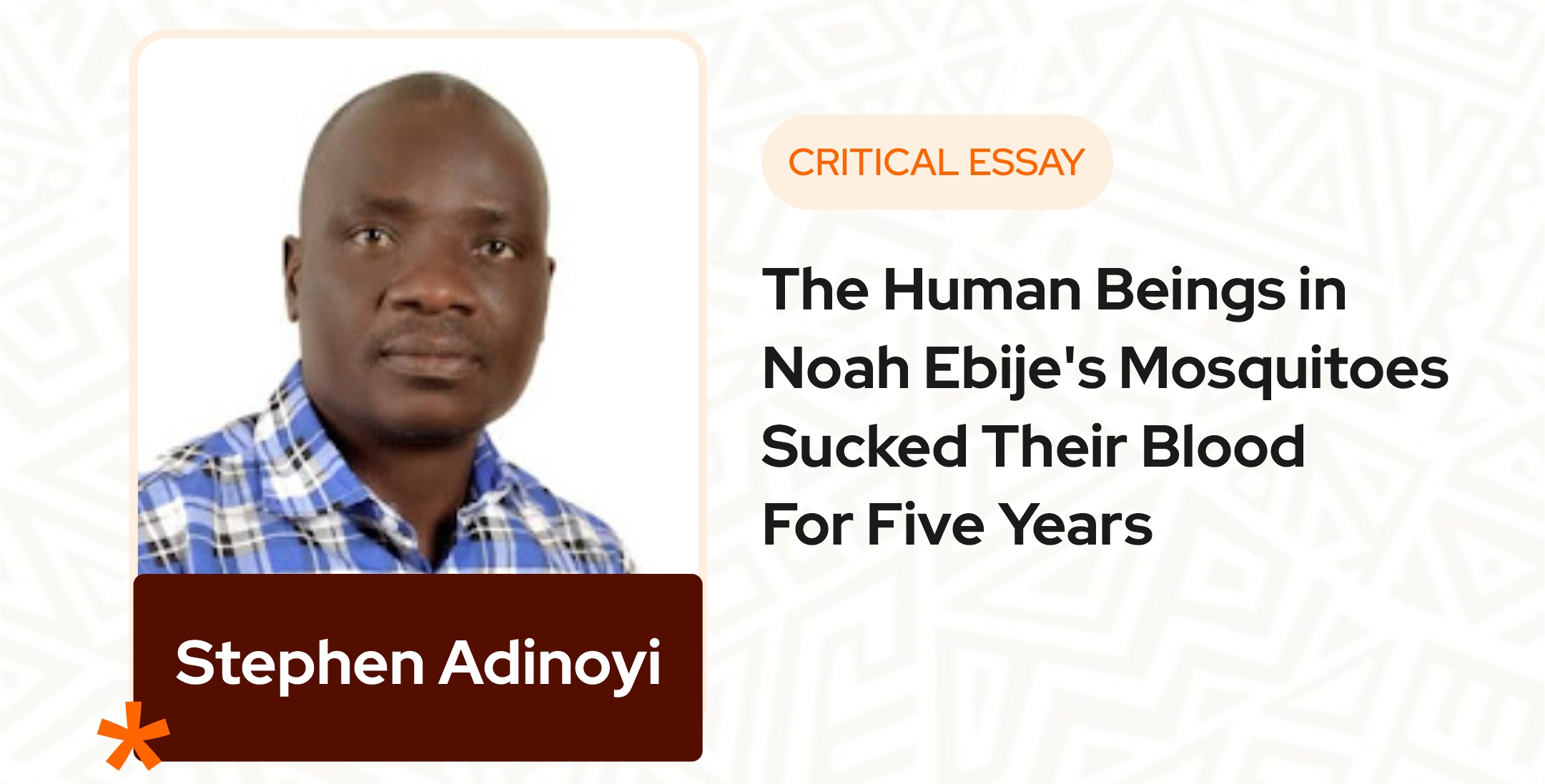
Stephen Adinoyi is a writer of plays, poetry and prose. His poem, Seoul, won the first prize during the 2016 Korean/Nigerian Poetry Festival. His poem, Divine Slavery, won the first prize for the 2020 Ibua Journal’s Poetry Competition. His short story won the second prize in the same competition. His creative non-fiction, The Fearless, which depicts the life of Nigeria’s most fearless female activist, Gambo Sawaba, won a prize and was anthologised in the Cost of Justice Anthology.
He has published two novels: Teen of Fifteen and School Girl. He has been published in Journals like: ANA Review, Ake Review, Ebedi Review, Ibua Journal, Naira Stories, etc. Anthologised in anthologies like: Fireflies; After The Curfew; Footmark; From Here to There; KISA/LEA Anthology; Achebe, The Soul Brother; Ninety Years of songs; (For Soyinka) etc. His pidgin play: I No Beta Pas My Nebor, was staged in Abuja in 2013 by SFEV. His pidgin poem, Crossover, was anthologised in a book called: If You Hear Say I Dey Prison.
As a 2014 Writer-in- Residency, he has been a fellow of the Ebedi International Writers’ Residency since 2014. He’s the chairman of the Association of Nigerian Authors, Kaduna, and former Chairman, Kaduna Writers League.