
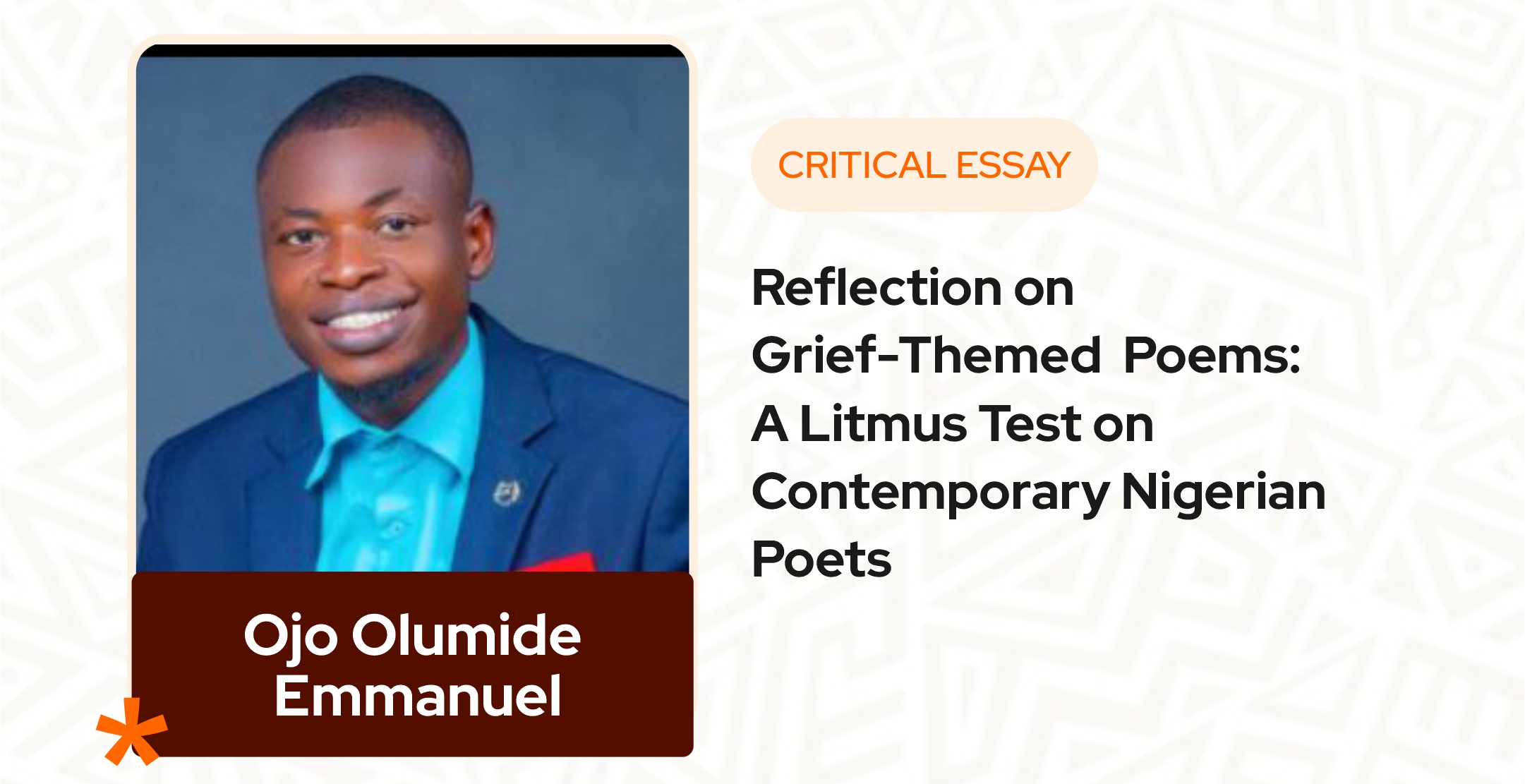
Recently, I checked the submission guidelines for a magazine, and it was boldly stated: Please note that Shrapnel is not currently publishing stories centred around trauma or grief. This repudiation would only suggest that they had received tons of works exploring this theme, just like after the pandemic, when most magazines would not want to consider any literary work that goes along that lane. However, would their caveat stop the world from grieving or interpreting its nuances in their own words when the ritual of grief initiates itself through a sudden loss? Chimamanda asserted that grief is a cruel kind of education. You learn how ungentle mourning can be, how full of anger. You learn how glib condolences can feel. You learn how much grief is about language, the failure of language and the grasping for language. [1] The subject of grief has become a recurring motif within the Nigerian poetic space, with more writers delving into confessional poetry by utilising the notion of memory, conjuring absence into presence, and utilising language to expound the deepest ache enmeshing the heart. Adedayo stated that “The poetry of grief and body is often decried in the Nigerian Poetry community. We’d have enthusiasts hanging their tongues loosely on Facebook comment sections, asking the writer to attempt to stop telling their own story, to attempt to stiffen their own loss. But the body, this body which we wear, has a way of reminding us that scars do not have to be physical” [2]. Chukwudera, on the other hand, disagreed with Adedayo’s postulation, arguing that “one of thebiggest problems among the poets of my generation is, arguably, the refusal to embrace thetrueconsciousness of the state of their art. The imagination is held captive without true consciousness. It is for this reason that it has been all too easy to sway scores of poets into a Passover of sorts. The poet, Warsan Shire, writes, ‘Nobody leaves home, unless home has become the mouth of a shark.’ And this poem is primarily written to explore the wars which have for decades torn and displaced people from their ancestral roots in Somalia. But the war is not just physical. It is also ideological. Shire is able to write such poems because she is conscious of those wars that rendered many who were once happy in their home as refugees in exile. Nigerian poets may not all be leaving Nigeria on boats in extreme conditions and being granted asylum; in an ideological sense, however, we are refugees fleeing our homes because the system at home has become like a shark threatening to eat us whole. But we lack the consciousness to observe that this is the reality we are facing, and hence, we face the risk of being deluded by the forces which define our arts.”
At different times in the history of Nigeria, poets or writers in general have been preoccupied with a range of themes from the cultural clash with colonialism to the euphoria of independence, the dashed hope that came with an independent Nigeria and then the days of civil war, military rule and the military-democratic rule of the present day.
The idea of grief poetry is not an issue for this generation of writers. During the military era, especially towards the end of the 90s and early 2000s, we have several protest poems which are more of a fight back tool against the repression and the inhumanity of the then successive military regimes. It was a social reaction meant to draw the attention of the regime and recreate order for a seemingly chaotic country. Writers at that time added activism- artivism to their craft. Gabriel Okara, in an interview, unequivocally stated that writers express their own ideal society, the kind they would like to live in and sometimes they forecast what the society in which they live will become in the future.
Chukwudera’s further appraisal on the current trajectory opined that “some writers presently think the recent trends in Nigerian writing, such as a focus on poverty, trauma and grief, are a result of writers expressing their artistic freedom. But the scorecard—a result of the output of Nigerian poets—seems to say otherwise. It does not even seem that poets are writing what they want to write, as opposed to what they are conditioned to write to make it to America. When poets put up the argument of ‘I write what I like’, they forget that Steve Biko, whose writingsonBlack consciousness espoused the philosophy of I write what I like, was writing in protest against colonial influences that plague African consciousness. Today, contemporary poets make the argument of ‘I write what I like’ to make it easier for them to submit to neo-colonial influences.” [3]
While in this present time, there is a shift from this order to a dispelling of emotion, it isimportant to state that these poets desire something better to enliven their hope irrespective of theinfluences on their craft because the poems written are more of testaments of the times we areinand the events that accompanies it than a protest for change or an alignment with the styles andinfluences of the American poetic tradition. It must also be added that the subject of grief has also led some young writers to depression and suicide, while others have also found their art as a coping mechanism to remain alive.
While there is an embroidery of meticulous choice of words, revealing symbols and implicative metaphors enmeshed in compressed, terse lines and verses, the majority of these contemporary poets, and up-and-coming ones, have treated the subject of grief in many ways and in many poetry collections and anthologies using different techniques, perceptions and literary lenses. Adedayo Agaraus’s “For Boys Who Went”, Pamilerin Jacob’s “Gospel of Depression”, SaddiqDzukogi’s “Your Crib, My Qibla”, Martin Deep’s “A Sheaf of Whispering Leaves”, OduOde’s“Calligraphy of Demon”, Samuel A. Adeyemi’s “Heaven is a Metaphor”, and a host of others are worthy examples.
3
Adedayo further stated that sometimes, memories are rags that beg to be rewashed, and this is why the poet cannot attempt/afford to stop inquiring about grief or the body. There may be several reasons why writers write grief-themed poetry, for instance, personal loss, depression, family issues, societal problems and the socio-political and economic conditions of their countries, and so on. When Samuel A. Adeyemi was asked by Semilore Kilaso in an interview on the subject of grief, he stated that “the subject of grief is inexhaustible, and being a Nigerian is primarily a contributor to it… It is difficult to write about butterflies and roses when people are dying in the street.” He succinctly captures this in his poem thus: “You call me poet, I am just nineteen & elevating GRIEF, all my verses, sibling holding themselves.”
Discussing the subject of grief requires that we understand how different poets have been able to explore it using the vehicle of language, mood, tone, and what they seek to achieve with the poem. It is important to consider the works of some poets as they treat this subject of grief, beginning with Rasaq Malik Gbolahan’s poem, “Ode to the Sea”, published in Transition Magazine.
In the poem, the poet addresses ‘grief’ as something tangible, like a catalyst instead of beingthebyproduct of whatever negative action or event that has been triggered: /the grief that startles thewaters does not have a name/ like the remains of the dead after a war…/ and the lines that followed opens the reader into the heart of the poet, articulating his mood and the emotionbehind his poetically ferried thoughts:/sometimes it appears that there are countless bodiessettling, like sediment, beneath the immeasurable body of the sea/ think of names buriedinthestillness of an evening, the fishermen returning home with losses to meet dying wives…/ Theimageries in the poem are quite intense, showcasing activities, for instance, the sea as usedinthepoem does not necessarily speak of a mass of water, although it appears so. Water here, like grief,
4
hides all things. This, the poet establishes: /that water, as simple as it sounds on our tongues, is a repository of grief…/ the poet ended the poem thus: /as another news of drowning reaches us, whose lives are cradled in despair, us whose names will dissolve in the water of forgetfulness when death leads us to the end of the world. / This is because everything in life ends in grief. In Saddiq Dzukogi’s poem “Shahada” on page 42 of his book “Your Crib, My Qibla”, the poet mourns his daughter in a way that makes grief appear light as the feathers of a butterfly: /today Baha is not dead- her tears reveal deep love for him. He prays his daughter’s hand turns the sponge that would wash his corpse – the rite of passage pressed into her forehead, a prayer mark from birth – in this dream state, he’s dying…/ The tenacity of this poem is to ignore the triumph of death and grief; to celebrate and recreate ‘presence’ and the beauty of once being alive, even in the deep-sea of grief. This is a new dimension to the understanding of grief, especially from a collection with fifty-nine (59) poems mourning a dead child, Baha. Although the repetition of “Baha is not dead in the collection may not be of self-denial, it is a new way to heal, as the poet expressed in the closing of the poem /Today Baha is not dead, she is the shield that repeals a surfeit of darkness from owning his body, an eel out of mud-water./ In Nome Patrick’s “Portrait as a Vagrant Walking through Grief to Meet God”, the reader is ledto a temple where the poet like a confessor, confesses his grief on the pages of a poem/everyyear, I grow closer to my own salvation thinking my shadow on the floor, wall, dancinginthepond is the feathers I need to touch the horizon. When we do shed the past of our bodies, as a serpent peels its skin for a new ceremony? A table was set before me, but instead of bread, instead of wine, the rot of an ache, the chalice of a grief, the spark of a wound in place of a candle, & above, a chandelier of mockery. every night, on my knees, i go in search of joy, crawl in God’s threshold like a wounded assassin…/ The palpitations in this poem are the intense will to break
5
out of grief by shedding off “its skin” and then bump into joy which the poet hopes he wouldfind in “God”, yet, this journey of grief begins from the beginning of the poem; /every year, i gohorsing the same path i trudged after realizing my mother’s body will never move of fromitsstillness & the grave will remain a closed jaw- a dried/. The symbolism of the “baobab” in African mythology is of a tree that houses spirits, and the despairing situation of the poet is that this particular baobab, housing his mother’s spirit, is “dry” and therefore cannot give up the body. Adedayo Agarau’s poem “Exit” explicates grief by utilising “the concept of body-poetry.”The poet calls the reader to witness the turbulence brewing inside him, since grief is a kind of turmoil: /on being broken like shards of withered glass, my body repels every music its soul makes…godtells me a compendium of broken birds are falling from the sky in my eyes, i ama fieldblessedwith dead boys or memories of them singing to me…/ The irony of this verse is that logically, glasses do not wither since they are not flowers, and the soul feeds on music rather than makes music according to a popular adage, but what would a grieving poet not use to express his emotions? And then he ends the poem: /because my body is an asylum, you come to ask if I am a safe place, god tells me to say no, say this city is too small to house a country or turbulence./ In Hauwa Shaffii Nuhu’s “When Sadness has no Words”, we see a poet trying to give words to the chaos in her mind /i am at the mercy of the dark, my head taking flight, my chest holding me in its teeth. all that is my body is struggling to kill me. i am drowning. i try to negotiate my way from beneath the waves, which, in a way, is trying to negotiate my way out of myself./ This poem is deeply personal and seeks to free itself of ache /i cry to release the heat trapped in my bones, these bones, both a house and path. i beg god for help. i try, i try./ and then she ends the poem/this thing turning me into a wound, is this what he had no words for?/
6
In conclusion, grief is hugely personal, even if it is for a country. It is also expressed differently by individuals, and language has remained the tool and vehicle to express, explore and heal from grief. When Olumide Olaniyan was asked in an interview why young writers in Nigeria today write grief-based poems and if he thinks it’s a trend that will fizzle out soon or just a testament of the despair in the country, he said, “The ocean of sorrow across the land is overwhelming. So, writing about it is one way to put everyone’s face and a call for action. Activism through poetry has always been with us, from the pre-colonial era to today.” It is therefore relevant to state that grief-themed poetry may never end as long as grief remains a part of humanity, but the craft of creating literary works exploring the motif will continue to evolve, and masterpieces will continue to appear even if there are casualties.
7
Works Cited
- Adichie, Chimamanda Ngozi. “Notes on Grief.” The New Yorker, 2020, https://www.newyorker.com/culture/personal-history/notes-on-grief.
- Adeyemi, Samuel A. “Heaven Is a Metaphor.” Up the Staircase Quarterly, 2020.
- Agarau, Adedayo. “On Processing Grief: A Review of Nome Patrick’s ‘The Body Walks Through Grief Towards God’ – A Review Essay by Adedayo Agarau with a Digital Collage by Robert Frede Kenter.” IceFloe Press, 2022, https://icefloepress.net/on-processing-grief-a-review-of- nome-patricks-the-body-walks-through-grief-towards-god-a-review-essay-by-adedayo-agarau-w-a-digital-collage-by-robert-frede-kenter/.
- Biko, Steve. I Write What I Like. Heinemann, 1978.
- Chukwudera, Michael Chiedoziem. “The Miseducation of Nigerian Poets.” R Publc, June–July2023, https://rpublc.com/june-july-2023/nigerian-poetry/.
- Dzukogi, Saddiq. Your Crib, My Qibla. University of Nebraska Press, 2021, p. 42. Gbolahan, Rasaq Malik. “Ode to the Sea.” Transition Magazine, no. 130, 2020.
- Kilaso, Semilore. “An Interview with Samuel Adeyemi.” Poets in Nigeria, 2021, https://poetsinnigeria.org.ng/index.php/poetry-does-not-scare-people-away-anymore-samuel- adeyemi-pin-literary-interviews/.
- Nuhu, Hauwa Shaffii. “When Sadness Has No Words.” Lolwe, 2021.
- Olaniyan, Olumide. “My Poetry Is Never Afraid to Throw Punches.” Interview by Ojo OlumideEmmanuel. LiteratureVoices, 2022, https://literaturevoices.com.ng/my-poetry-is-never-afraid to-throw-punches-an-interview-with-olumide-olaniyan-by-ojo-olumide-emmanuel/.
- Patrick, Nome Emeka. “Portrait as a Vagrant Walking through Grief to Meet God.” Agni, no. 94–95, 2022, pp. 194–195.
Ojo Olumide Emmanuel is a Nigerian poet, educationist, and Book Editor. He is the author of the Poetry Chapbook “Supplication for Years in Sands” (Polarsphere Books, 2021) and “How Flowers Pollinate Before the Arrival of Butterflies (Authorpaedia, 2022). He is the winner of the Nigerian Prize for Indigenous Language (Pidgin, 2025) and WeNaija Literary Contest (Non-Fiction, 2023). He is a best-of-the-net nominee.