
Abstract
The works of male writers and critics formed the foundation of literary scholarship. However in recent times, female critics and writers have emerged to challenge the patriarchal system by emphasising the experience and conditions of women. Feminist rhetoric is anchored on the resolve to dismantle binaries that seek to inhibit women in the society. The hallmark of African creative and critical feminist enterprise has been to create a model that is suitable to African tradition and climate and, to dissociate itself from the radicalism of the western feminist model. This essay focuses on these rhetorics and the articulation of the tenets of feminism in African literature. Using Zaynab Alkali’s Invisible Borders as a microcosm, it interrogates if these discourses facilitate or impair the ultimate goal of female emancipation. It concludes that the novel under study encumbers full female independent identity.
Introduction
Feminist poetics goes back in history. It has been widely established that Plato’s The Republic and his principle of differentiation extends its discourse to include sexual relations and Aristotle’s declaration that, ‘A female is female by virtue of a certain lack of qualities’ violating this precedence by defining the woman in relation to the male has evoked responses. In modern times, feminist discourse has soared on the revolutions following advancements in the society to demystify theories that seek to define the woman in relation to the man. It has capitalized on the tenet of the industrial revolution-‘equality for all’ to make a case for the creation of space for women in economic, political and social spheres. Simone de Beauvoir espouses the intersection between these relationships in The Second Sex. She posits that the male controls the social strata because they possess the economic means. This leaves the female in the lurch of dependency which is converse to self-assertion. Their attachment to the male makes it a struggle ‘to become’ under the heavy concentration of male influence.
Another perspective to feminism; gynocriticism, centres on female character, author and female experience as the markers of authenticity on notions of gender relations and reality. Here the ‘truths’ embedded in the narratives centred on the conditions surrounding women come under scrutiny from authorship and source. Female writers are designated as credible and possessing resources which allow for frank representation of issues such as divorce, single motherhood, adultery, prostitution, lesbianism, etc. However, If this claim is premised on Michel Foucault’s argument that, ‘what is true depends on who controls discourse’ it opens up a lot of issues. Given and in a literary sphere mostly controlled by the patriarchal ideology, it corroborates the theory that misconceptions abound even in the depiction of women in the writings of women too. It therefore becomes pertinent to interrogate the ability of the female writer to rise above bias and, internalized stereotype that the male writer has being accused of. Beyond representing the distorted identity imposed on being female, is the woman writer able to carve a vision for her kind and amplify positive voices and experience to drown shallow judgements that do not give allowance for female self-actualization? Female writers tend to justify adequate representation of contemporary issues that plague its tribe by emphasizing her abuse, suffering and mistreatment in the society.
The African female writers have emphasized the female struggle in their quest for re-constructing female identity while giving allowance to cultural dimensions. In his essay, A House Divided: Feminism in African Literature, Charles Nnolim characterizes the older generation of female writers like Flora Nwakpa, Mariama Mba and Buchi Emcheta as accommodationists of both African ethno religious and feminist’s ideals. These writers he pointed out are primarily concerned with the issue of gender, identity and experience with its inherent conflicts, while rejecting western radical feminism. However, we would like to take Buchi Emecheta from this set that does not transcend given social reality and so offers no vision of gender equality. This is because Emecheta’s title Joys of Motherhood in new interpretative modules is given to be ironic and she has proven to be transcendental. So we would group her with the latter generation of African writers.
The latter generation emphasise women perception of their society and how female experiences shapes and sharpens responses in Literature. Emecheta’s Joys of Motherhood, Sefi Atta’s Swallow and Lola Shoneyin’s Secret lives of Baba Segi’s Wives mirror this by interrogating internalized perceptions of the woman and the untruthfulness of such labels, stereotypes, and identity. While the former set established identity conflict by wielding plots that contrast the role of women side by side with their male counterpart, the later shows the woman as an independent entity that need not be defined in relation to constructed gender identity. This set is considered radical as it solely focuses on female experience and desire with no regard to the ego or desire of the male.
Female writers have evoked criticism that has given birth to such female ideologies as womanism, stiwanism, motherism, femalism, nego-feminism, etc designed to mirror the peculiar experience of the Black woman as opposed to the grand narratives imposed on all female cultures without regards to heterogeneous idiosyncrasies. These variants have common feature of encouraging women to imbibe the culture of negotiation and compromise towards accommodating all sexes. Chinyere Nwangbara summarizing this variant while subsuming Nnolim thought on this posture states,
Womanism advocates a meaningful family life but insists that men change from sexism. Nnolim believes this ideology explains why women writers do not end their plots with feminist victories. The accomodationists he says do not preach total equality with their men. They concede leadership role to men (29).
This calls into question the impact of compromises in power relations between the genders. Conceding leadership to the male automatically places him above, thus giving him the position to determine the destiny of the woman. This is counter-productive and a contradiction to the struggle that some feminists claim to champion. Nwagbara defends through a different perspective. In her understanding, ‘African feminism is a hybrid of sorts which seeks to combine African concerns with feminists concern…issues are no less vexatious’ (33). This thought however, seems to forget that the African world view is mostly shaped by patriarchy, and this serves as the foundation of most feminist’s rhetoric. Nnolim only highlights the contradictions in feminists’ discourse. This can only be viewed as a legitimate concern when viewed with the understanding of the system of patriarchy starting from its pre-colonial history. It has always been argued that African culture mostly favours the male.
The focus therefore should be in the scope of narrative and its elements towards creating a change in the experience of the woman. According to Akin Olaniyi, basing her argument on the capability of African worldview to provide a framework for critical discourse of African literature, Nnnameka in 2003 proffers another model- Negofeminism which
…situates her African feminism within the confines of an indigenous, concillatory, non-combative domain to redress gender imbalances in Africa. Aptly tagged nego-feminism, it advises women to imbibe the virtue of ‘negotiation’’ and ‘no ego’ to achieve the desired end. (51) .
to a large extent Olaniyi’s position when viewed from Jameson’s construct of ideologies, as ‘strategies of containment’ is limiting. Culture in Marx’s realm of ‘a construct from the historical conditions in which human beings create their material lives’ amplifies Nnameka’s cultural imperative of this model which highlights universality and fluidity; cultures which are ‘modulated by ever shifting local and global exigencies’’ (377). Similarly, the admonition of the female to cancel her ego is denying her dignity as a human while giving ‘no ego’ as virtue is operating in the provisions of a structure of binary oppositions which renders the exhibition of ego as a lack of virtue which is in consonance with Aristotle’s view of the female. What Nnameka proffers is humanism as it urges the world to downplay ego in gender discourse. To do otherwise would be the bane of feminist challenges.
Alkali And The Feminist’s Mirror
In Nigeria, given cultural and religious practices, female writers have created characters in their works, who device methods of self realization and assertion operating within the constraints of these cultural and religious offing without eroding its values. Zaynab Alkali falls in the category of such female writers who are mindful of the cultural and religious configuration of the society they write from and for. Her liberal posture has brought most of her works under scrutiny, with critics questioning her position especially on the marriage institution. The system of gender discrimination in most societies thrive on traditions and cultures entrenched by patriarchy and most radical feminist believe that, to battle the system, there is the need to interrogate the perception that places the male as custodian of female happiness, achievement, especially those that hide under the guise of of religious and cultural systems and practices.
Alkali who belongs to the older generation of female writers recreates female experience through her works and seems to align with the the African model of feminism. Her earlier works reinforces this stand where women within the confine of the African patriarchal culture are bound to the men. In The Stillborn for instance, Li, Faku, and Ifeyinma leave for the city because their husbands deem so and their opinion is irrelevant in these decision. These women are portrayed to possess a meaningless existence which is only given significance in their attachment to these men. The heightened consciousness that followed this rendition, in the wake of feminist criticism perhaps accounts for the slightly different posturing of Alkali in The Descendant. However, her 2016 novel The Invisible Borders does not fall short of her original inclination towards cultural accommodation of African ethno religious values in the feminists’ quest of emancipation. Alkali is a writer whose major preoccupation revolves round the woman and her experiences in the society. Her work, The Descendant for instance centres on the the woman, the injustices meted on on her and her liberation from social and cultural oppression through enlightenment, either by the acquisition of education or through experience. Aside themes of abuse and exploitation, she also touches on the health of the girl child by bringing to the fore the complications of early motherhood. Seytu is given in marriage to the village head of Dam at the age of twelve and the outcome- ‘…now she lives with a condition where her vagina walls are badly damaged, awaiting surgery…’ (29, The Descendant). In Invisible Borders, she yet creates space to bring to light the medical conditions women are exposed to as a result of rupture and vulnerabilities of their biological configurations.
However, this paper examines Alkali’s novel, Invisible Borders in the light of Post-Structuralism in opposition to traditional structuralism that African model of feminism is based on and that pervades Invisble Borders. Through her narrative, she grounds that ‘definite sets of relations (oppositions, sequences of functions or propositions, syntactical rules) underlie particular practices, and that individual performances derive from structures….’. this is a major principle of traditional structuralism as given in A Reader’s Guide to Contemporary Theory. By adopting a critical reading, the feminist perspective which should align with post-structuralist orientation as a tool of examination is brought under scruitiny. This paper examines the role that the experiences and background of writers play in shaping their worldview on female identity. Through careful reading, the notion of female repression is positioned as a practice internalized to stifle individual female identity. In the following discourse, it advances to interrogate female docility and passivity, and the posture of accommodation of male domination as a manifestation of assimilated cultures of subjugation. It goes further to put forth the feminists’ arguments on identity and misrepresentation. By pointing out grey areas and contradictions of the African female mantra of liberation/freedom and emerging ideologies, it concludes that feminists’ discourse should be left in the post-structuralists’ deconstruction of binaries. Any attempt to impose ‘instruments of containment’ (ideologies) on it amounts to denying the arbitrary nature of human relations, ultimately denying how dominant discourses reinforce patriarchal power and marginalized women
The material condition under which one operates ultimately embody experience. Hence, putting the woman in a fixed position socially, politically, economically, morally or otherwise undermines her humanity and leaves her exposed to abuse of all sorts. It is impossible to isolate gender stereotyping from material conditions in the society. Just as class, ethnicity and experiences cannot be dismissed in any approach to feminist discuss. For example, Queen at ‘The Casualty’ in Alkali’s Invisible Borders was a casualty of life at a very young age, been orphaned, she is exposed to an early abortion and a life of prostitution which leaves her diseased and destitute. Alkali gives allowance for her redemption and she is restored after surgery unlike Lemmy who is from a privileged background, so judged and condemned to live with the consequences of her ‘recklessness’. This is unlike the allowance given Yellow Yellow in Kaine Agary’s Yellow Yellow that violates the notion of intrinsic merits of character, but is not judged by Agary who chooses instead to create a protagonist who does not use unwanted pregnancy to halt her aspirations. Although, she may not be labelled or cut-out to be pro-abortion, she is liberal enough to give allowance for mistakes and chose rather to side with Mina Loy by dissociating from the fictitious value of women being identified with purity. The loss of Yellow Yellow’s virginity to Admiral Kenneth would have conventionally signalled the defeat of her stance towards self realization but for the allowance of the Feminist Manifesto, she is given a second chance just like Queen in Invisible Borders.
Female treachery, passive piety, female ideals and morals are themes that run through Alkali works. Where the women are depicted as conformists, the men are portrayed as rascals. The idea of morality operates in the realm of evil and in binary opposition of visions of goodness. At the core of female writing is the proposition that the displacement of fixed gender identities is essential in the demystification of binary oppositions sets such as the weaker and stronger sexes, nurturer and provider, etc. While women writers have always worked to dethrone the erroneous belief that seek to elevate patriarchy over matriarchy, multiple outcomes abound in the process of interrogating these grand narratives. This may eliminate foist identities or stereotypes or perpetuate them unconsciously. The practice of undermining ‘phallocentric representationalism’ is also projected through the violation or distortion of fixed biological roles or forced expectations on womanhood, Alkali consciously or unconsciously reinforces this in the last chapters of Invisible Borders, Lemmy’s mother disclosed her premature menopause to the husband, unknown to Lemmy. The narration gives that,
Lemmy lacked for nothing except for her menstrual periods which had ceased at the age of twenty-eight…Lemmy had commited three illegal abortions, using a drug substance prescribed by a notorious herbalist. She never saw her period again after the last abortion for seven years.
Consider narrative’s choice of diction; ‘lacked’. Lemmy is given as deficient. Although a lawyer, she is unable to come to terms with the reality of her infertility, it only took the courage of her mother who was liberated in mind to damn the consequences by daring the full disclosure of her daughter’s medical condition to her husband before their marriage.
Similarly, while women’s biological features such as the womb, ovum, uterus, rather than define her as fragile, disadvantaged or inferior, should be celebrated as an endowment, in the advent of infertility or ‘deficiency’, the woman should not be conned into accepting an identity of inadequacy. In the Novella, the dexterity of narrative to validate male construct of female identity is established as far back as 1980 at the Yeme Hospital. Saddled with the burden of ‘a child to cement the bond of love between her and her husband’, Ajus at forty-two considers going through surgery, leaving many in wonderment,
Queen was amazed at such a sanitized existence. A clean woman, who had never known another man in her life, yet was unable to conceive even for once. And here she was, her life full of garbage. She understood Aju’s intense desire to experience motherhood, but she wondered if it was worth the risk at forty-six years, seeing that she had a loving husband, a caring and functional family. (152)
While there is the need for an insight into the faculty sold to the woman that spells ‘complete womanhood’ to be a product of being a biological mother, the narration above discredits the notion that designates ‘purity’ as a marker or pre-requisite of fertility while at the same time scoring a point against the traditional notion of female wholesome existence being premised on the slippery scale of purity, and which is often used to measure and predict a woman’s outcome in the society. The pressure generated from internalized responses in this case leads to her death. Ten years after the fatal surgery, Alhaji lives with regrets and inculcate new ideals on the importance of education for both his female and male children. To say the least, the hint that education is a liberating force to the female is a grand narrative in itself as ‘educated’ women are not entirely liberated from internalized ideals of womanhood sponsored by patriarchy.
Although, Alkali creates space for female issues like womanhood, fertility, and self-hood, the prevailing tone of Invisible Borders largely replicates relationships/binaries between the male and female gender in the society rather than creating a vision of equality. To Alkali, the world is comprised of binaries, good/evil, moral/immoral, etc. And so her character’s actions and her creative enterprise is determined by this concept as exemplified in the judgement meted on her characters. Based on this construct, a good man deserves a complementary woman, and a bad one be booted out. An immoral woman should be celebrated and her inspiration honoured while an immoral one is irredeemable. She operates within the confines of society. Anything short of that is a mirage that she does not want to contribute to. The immoral Sam is therefore condemned with female children and Safia ‘blessed’ with all boys. This representation in itself unconsciously validates the patriarchal system that sees the male child as a blessing and the female a curse, burden or trouble.
Similarly, the temperate responses of characters to issues call to question the truth of her narration. Although some postures may be excused on the dynamics of human attitude, reactions and responses to events, how can one reconcile the emotional abuse suffered by Safia from Sam, and the exchange that followed the reflection of his life. Safia is portrayed as emotionally dependent on forces outside herself. The legitimizing tone of narrative on the continuous hold to Sam and his memory seems to suggest that the African woman is empowered to bear the emotional, physical and psychological degradation of patriarchy.
‘Fire begets Ash,’’ Safia said quietly.
No! Safia, he was not ashes. Sam was a raging fire. Look at his contributions to this community, the district and the state. He was a senator for years for God’s sakes!’’ (103)
Consider the vehemence with which Mithia defends Sam despite her daughter being a victim of his moral bankruptcy. If this is typical of encomiums poured on the dead, it is yet to explain Safi’s decision to attend Sam’s burial. If it was a matter of closure, it reinforces the notion of female dependency. It is this culture of holding on to the mundane that needs to be replaced by a different vision of female self-actualization. Thirty years after, Simfa is still judged, ‘We all have to answer to certain behaviours at some points in our lives,’’ (97). Safia goes further to put blame on Aisatta, ‘Great bitch,. Aren’t we women always doing this to ourselves?’ (85). The female is always blamed for the male’s moral bankruptcy as if morality is an exclusive virtue of the female.
In the narration, Sam is represented as an enigma, especially at his burial. Alkali captures his escapades with women as a conquest or as a stamp of male power;
There was hardly a life in Tilla he had not touched. His wives, ex-wives and claimant to marital status, from the ages of twenty-three to sixty-seven, sat cradled between sympathizers, each mourned for a different reason and he was barely fifty (11).
The tone of narration serves a marker of the endorsement of the life of Sam, rather than the perception of her characters. Alkali’s Invisible Border has created a world dominated by men; one where the female is defined by her relation to the man. The fact that Safia’s husband represents male identity that guarantees the stability and balance of the woman clearly points to the paradox that continues to excuse the meddling of male presence in female self-realization.
Although she manages to create a vision of a failed male enterprise in relation to the female characters, it is pinned to a certain lack of attributes. The male characters are constructed as immoral, clueless, puns, disappointments to the community or simply as fated, and so they are condemned to a bad ending. This she does by highlighting the benevolence of a patriarchal culture that accommodates and sanctions male’s actions and decision and so allows them rise in status in, and so their fall is great. Having internalised this culture that defines everything within the worldview of good and evil, the rich and the poor, the powerful and the weak, the society accommodates and tolerates the excesses of the men ultimately adopting and perceiving their actions as the norm. This builds up a culture of oppression premised on an ideology of control shaped by the powerful.
THE MARRIAGE NARRATIVE IN ZAYNAB ALKALI’S INVISIBLE BODERS
Women writings have always scored a point for women struggle and liberation, however like other binaries; there remain gray areas and controversies that need to be fully resolved before one can talk about female liberation without inhibitions.
In this context, querying would mean to interrogate the ideals of feminism in relation to its conceptualization on marriage. Characterization in most literary works termed ‘feminist oriented’ present female characters that rise above the limitations of their oppressive backgrounds, marriage abuse and sexual harassment. The plot usually revolves round a disadvantaged protagonist that decides to assert herself through self realization or enlightenment against the prejudices of a male oriented society. However, despite the advancement in African feminists’ discourse, Alkali’s Invisible Borders presents a reverse situation, where the selfhood of women who are privileged, educated, enlightened or properly placed in the society is determined by the Phallus, who punctuates or truncates it as it desires. Safia’s happiness is tied to the mystery that is Sam and she is unable to attain full happiness as not until his death was there full disclosure of the conspiracy that led to their failed relationship. We are presented with the Phallus messing with the happiness of the woman through the promise of love, security and marriage.
Similarly, Halima is psychologically disoriented when her husband (Babs) takes a second wife. It seems a high premium is placed on love and marriage which hitherto leaves the woman in the lurch of unhappiness. Her security and relevance in the society is measured by her status in marriage. The feeling of inadequacy felt by the woman is not abated despite her educational achievement; Halima wonders why Babs had to take a second wife. Safia’s endorsement of Babs as an ideal husband soon turns into a joke as she is jolted from oblivion,
What was his excuse?
The usual excuse men give when they desire another woman…..In fact the girl will prove to be an asset. She will help you’’. Help? As if i need help in that department’’. The two roared with laughter (127)
Again the restless Phallus dictates to the woman his desires and patronises her into accepting it as a necessity. The second wife is also given as an asset to be acquired for the comfort of both his pregnant wife, and his sexual needs as a man. Again the woman keeps calm just like Ramatoulaye in Mariama Ba’s So Long A Letter; an epistle on the ravages of polygamy which womanism rejects. Womanism traces polygamy as a design of patriarchy hiding under the facade of religion and so abhors it.
Consciously or unconsciously, Alkali places high premium on marriage, in her works, we are presented with characters who are either divorced or widowed getting remarried; Mithia remarries several years after the death of Maaji, Seytu goes through marriages and divorce, Glo Medina is cajoled into accepting to be a player in the marriage institution, etc. It seems that Alkali aligns with the cultural background or notion that marriage spells stability for the woman as this is resonated in her works. While this suggests or points to her practice of creating a balance between family ideals and female emancipation, it yet reinforces that the phallus determines the security of the woman. Marriage forms the social background of most of her works and, historical ties are traced and established through marriage. She has over the years developed a literary dexterity in tracing the genealogy of families based on her mastery of the institution. For instance, the tragedy that led to the death of Sam and Talatu’s parents occurred as a result of Dani’s wedding. This left Sam in the care of Dr. Maclean, and set in motion his close brush with the medical career and his disillusionment with life after his scholarship was withdrawn by Dr Mclean based on adjudged moral misconduct.
Alkali makes a strong case for marriage and almost always gives closure to any condition surrounding it. While it may be a conscious resolution she adopts to dissociate from the radical breed of feminists, it may well spell her non-committal stand in lending her voice to the need for women to be liberated from the injustices that women may confront in the marriage institution. In contrast to the accommodating posture of indices of trauma and psychological alienation that are the hallmark of abusive marriages, there’s the need to emphasize on channelling the female energy towards a larger vision instead of domestic issues. Female characterization should depict strong female figures capable of making their marks in politics and occupy positions of power in the society. Only then would women advance and aim beyond being relegated to the ‘kitchen’. The female must be well equipped mentally and psychologically in order to be able to influence and determine her outcome in a society chiefly dominated by the Phallus. Alkali, leaving the female [Safia] in the lurch of dependency which necessitated the female struggle for liberation in the first place is counterproductive and undermines the feminists’ manifesto.
This is evident in the puzzle underlying Safia’s sense of entitlement or self-imposed duty to bury Sam. What responsibility does she hold claims to? Why did she risk a turbulent birth instead of absence at the burial? We see the repressed distress and emotional struggles she passed through in her journey to womanhood filter to the surface. Indirectly posing the question she had brooded upon earlier on, ‘ was it curiousity, or even a misplaced loyalty to the dead? (12). Tracing from the cordial relationship she enjoyed with her father, one is left but to wonder where she picked up the unconscious posture towards a torturous relationship in the name of love. Safia moves from an erratic and spontaneous character to being deliberate and calculated in her responses to events that directly affect her. This is in consonance with an internalized culture of female silence imposed on her which hitherto stifled her personality; if you may her identity. This response is a contradiction to the ‘fight against the grain’ that feminists are involved. The in-story in Tracy Chima Utoh’s Our Wives Have Gone Mad Again of the castrated man upon which Inyang models his treatment in the hands of Ene is typical of an expected reaction to male infidelity. In the story in the play, the man’s ‘instrument of enjoyment’ (37) is cut off. E.B Adeleke’s critical statement on this action both captures and mocks the perspective of the radical feminism,
The man’s penis is not only his biological indication of manhood, it is also the archetypal symbol of male power, authority and simultaneously the woman’s chief instrument of torment as well as enjoyment…Falilat’s attempt to damage her husband’s manhood comes across as somewhat irrational because it amounts to a paradoxical damage of the good side along with the bad. The implication is that the woman gains liberation at some cost to herself too (104)
Space has been given as it both shows the fear and aspirations of African feminists, as well as the perspective that feminist ‘fighting against the grain’ should seek to demystify feminists discourse dominated by inhibitions to multiple possibilities aside the patriarchal model. It similarly highlights significant historical responses while raising the question: why has Alkali in 2016 relegated the woman to the position of silence? Apart from the literal, clinical cutting of the phallus, one would have expected a symbolical castration. Instead in Invisible Borders, the phallus is let loose and on rampage to wreck emotional and psychological havoc on many. Although Adeleke’s task seems to be in establishing the evil tendencies of the female and her capabilities which is all encompassing, he presents a valid argument on the need to emphasise the multiple capabilities of the woman when situated in the larger system of hierarchy. When a woman is put in a reverse condition, she assumes the dominant role. However, his notion of evil, good, extreme etc chaos is over-reaching and so tends towards dogmatism which post-structuralism rejects. Critics have to be careful to concentrate fully on the task of interpretation rather than passing judgements,
POLITICS, SEXISM AND GENDER
There exists an undeniable relationship between gender and class which has resulted into different forms of inequalities. Ranging from economic, political to social imbalances, the system of hierarchy has always favoured the male and placed him above the female. Social identities are built along structures which reinforce hierarchies in the society. Economic institutions, social ideologies and political dispositions are framed along lines that privilege the man above the woman. The emergence of female writers has given multi-facet perspectives to the issues of power relations between genders which are widely recreated in literature. There have been attempts to correct or debunk existing tradition that tend to esteem the male ego to the detriment of the female. The devaluation of the female and the culture of suppression have been represented to reflect the injustices of a highly stratified society crafted by the phallus to limit the woman. Inequality perpetuates discrimination against placement in meaningful position. This is a manifestation of class disparity as a result of uneven wealth distribution resulting in the high entrenchment of the culture of female subjugation. This accentuates the tradition of phallocentricism that tend towards the empowerment of the male and deprivation of access and allowances for the female to make significant progress in the society. With the incursion of feminists’ movements, women have advanced beyond the frontiers of domestication and have continued to fight new attempts to relegate them to the ‘kitchen’. However, some writers are yet to fully advance this consciousness.
From the forgoing it would be apt to emphasise that the political terrain in Invisible Borders is dominated by the men folk. While this may have been an oversight, it spells largely on what is obtainable in the Nigerian political space. Lady Macbeth as far back as Shakespearean times is fully involved in the evil designs/politics of her husband. However, Alkali in the 21st century has completely taken the woman off the political scene. The woman is portrayed as a mere appendage,
Three months after the fiasco visit, Sam went to Savanna and married a young girl called Bintu. Bintu was the daughter of the Political Adviser to the Governor of Savanna State. A week later, his godfather, Retired Captain Gaga, married the daughter of the Emir of Savanna State. It was widely rumoured that the duo believed the two marriages were a good political strategy (94).
Again women are exploited through marriage as acquisitions to aid campaigns rather than for mutual companionship. And all through the narration, there is no mention of these wives. They only re-emerge at Sam’s burial to revalidate the influence of the man.
Whether Alkali was trying to shield the female folk from the kind of ruthless politicking that Sam and Gaga were involved in or to show that the women were not capable of such ruthlessness, either ways, she succeeded in scoring points for patriarchy by highlighting elevated binaries like weaker/stronger, the male/the other sex, etc that exists in the society. In the novel, the duo is reported to possess economic means to perpetuate their political ambitions, ‘In their bid to win the elections, they had lined the pockets of the traditional and religious leaders’ (99). Simfa on the other hand, had nothing to offer except trade her sexuality in her quest to be liberated from consequences of poor choices. This is yet stifled by the great measure of control exerted by Sam and Gaga. Male power as a corrupting tool against female value system which undermines suffragette sisterhood is also highlighted. Although these women are educated in their own right, they are docile, domesticated, not self-willed and unenlightened and so their actions and line of thoughts are ultimately controlled and determined by men. The onus lies on the writer to create, stimulate and sharpen the consciousness of the female.
It would seem that, the invisible borders that Alkali refers to would be the controversial lines that exist in social structure regarding sexual relations that Sam seems to always violate. Borders, if and when crossed complicate the true nature of one’s integrity. In Sam’s case, there seems to be an overlap in the true nature of truth and deceit. Either way, he is not absolved of the play out of his destiny or the outcome of his action or inaction.
Safia, there was a third time. Did you not listen and accept him then? Tell me, what did he do to redeem his image and claim the innocence he said he was robbed of, enhn? He, again, indiscreetly got involved with a strange woman, who was later discovered to be Gaga’s mistress. Like Simfa, she also carried Gaga’s seed when he got involved with her, (103)
This narration aptly summons the politics of ‘god-fatherism’ in Nigeria. The political son or protégée is always compromised to cover up the excesses of the mentor. In the case of Sam, he was a clueless pawn used to hide the moral bankruptcy of Gaga. When he crossed the sexual borders of fraternizing with his mentor’s women, he is wrongly implicated in Simfa’s pregnancy the first time, and the second time he is roped in yet another incident. Although full disclosure was given at his death on the injustice meted on him by Gaga and the deceitful Simfa, he is not totally blameless in the fate that befell him.
In another vein, there is the paucity of women at the higher echelon of political leadership and one would have expected Alkali to create a vision of social change where women are involved in the democratic processes instead of merely portraying men as evil or bad politicians. Providing an alternative by promoting female hegemony is key in establishing alternative hegemony. More so, since male control saturates all levels of power as a play of hierarchy in the society, one would have expected that a male is carved out to aid the process of female emancipation. But this is not the case, even Sergeant T.J, Musa turned District head is not sympathetic of his niece’s (Safia) history of pain (which he is privy to), He is rather marked as a co-male conspirator to sustain male hegemony. He shields Gaga instead of exposing his deceitful scheme. It had to take a twist of fate to deliver poetic justice on Gaga.
The intersection between the concept of sexism and gender constructs is also given space by Alkali. Safia picks little details such as- ‘‘She had not failed to notice earlier on that her form had remained on the desk until the last man had entered’’ (118). She is also quick to correct Sufyan assertion, that ‘it’s a man’s world’ (112). Similarly, in the epilogue, Alhaji made sure that his children both male and female got the best education, ten years after Aju’s death. And Didi notes the evolution in the advancement of traditional allowance given to the woman in the family and society.
Narrative seems to go against itself at different points, most of Alkali’s female characters are financially dependent or beneficiaries of gifts from the male characters. Dani is reported to have married a rich businessman (30), Lemmy is reported thus, ‘ …She did not care about him, but enjoyed what luxury money could provide’ (153). Although Safia is not portrayed as materialistic, she receives gifts of jewellery from Sufyan, and ends up working in his hospital. The women are financially disadvantaged compared to the men folk and, on another level; they have unconsciously imbibed the culture of being perpetually at the receiving end.
Conclusion
There is a clear demarcation in the portrayal of the experiences of the male and female gender in Invisible Borders and this is reflected in the relation of one with the other. This renders the title ironic as it attests to the existence of borders but denies the glaring fragmentation of these borders in the face of advancement in consciousness, class and status. The stark disregard of the overlap of these borders or their fragmentation is the undoing of any narrative on inequality. Perhaps INVISIBILITY refers to the unconscious ideals/manifesto internalised by the society as dictated by the patriarchal system,
Alkali’s Invisible Borders offers no contrived visions of a new social order. The system of control and oppression is maintained and the tempo of inequality in gender relation sustained. A pattern of progressive transition in the consciousness of Alkali’s characters would have clearly translated into a vision of female emancipation but Invisible Borders is stifled by narrative’s adherence to societal expectations and upholding its contrived norms. Although it is remarkable that, the protagonist having suffered the psychological turmoil of a lost love, refused to settle for less choosing rather to let go of Sam who died fatally as she may well have been rendered widowed at a young age, and left to yet suffer the consequences of his recklessness. The most important highlight would have been her ability to let herself heal emotionally after she gets married to Sufyan. However, there’s hope for thefemale; Halima got past her disappointment of been fated to polygamy, Queen is privileged to get her degree just as Talatu resigned to adult education as last resort to make up for her lost years to caring for Sam.
When narrative represent visionary female characters that assert themselves by taking charge of their destinies, desires and happiness, only then would women possess the power to consolidate the feminist ideals. Although, Safia and Halima are cushioned by their busy careers in medicine, Alkali ultimately succeeded in elevating the culture of dependence which put the male at the centre rather than create a balance. Instead of the outright relegated or ignored position she is placed, the woman is repressed psychologically. This is an inhibition to her total emancipation. Alkali loses her ideological standing in her attempt at creating a balance. For what is fiction without ideology? In ideological novels, writers often link their vision and narration to reinforce the preoccupation of such works. Doing otherwise leaves many questions unanswered. Most times, hierarchies are accentuated; structures that elevate the ‘super’ above the ‘other’ are prominently developed in plots to reflect the dividing lines in the society. The binaries that exist in Invisible Borders often times are fully developed and while Alkali doesn’t deny the imbalance in gender relations that exists in the society, her vision of creating a balance has resulted in maintaining binaries that needs to be interrogated in the larger system of domination in the society.
Similarly, as an oppressed tribe, one would have expected a vision of emancipation pioneered by women. Where women speak and stand for themselves rather than being spoken for. In a male dominated society, and the visible influence of her mischievous young uncle; TJ, Safia is initially portrayed as a child that asserts her individuality but as she attains the age of consciousness and advances into adulthood she becomes timid, and exhibits an unconscious manifestation of a repressed identity. She gets entangled in the web of dependency on the male which she clearly assimilated from the culture of a phallocentric society. Instead of being confrontational, she becomes an escapist; first she hides under her studies to run from the village to escape her hurt in and secondly, she is clearly not liberated from the trauma of the past and seeks closure by endangering her pregnancy (life) to attend the burial of Sam.
Alkali’s Invisible Borders can fully be appreciated when viewed within the system of patriarchy which has projected a culture that has genders locked in given attitudes and destructive tendencies peculiar to the genders. However, the disclosure of this system would hitherto demystify the current African feminist discourse which does not acknowledge the foundation of patriarchal domination. The whole concepts of accommodation and balance if not properly conceived may result in grand narratives that sustain male authority and validate the phallus thereby throwing the feminist discourse into more troubles of contradictions. Similarly, the concept of free-play should be imbibed by feminists (writers and critics) in the quest to empower the woman. They must adopt the best possible approach in invalidating a system of oppression. To label Invisible Borders a feminist text is to contradict the most obvious preoccupation of the text.
Works Cited
- Adeleke, B.E. Interrogating Misconceptions of Feminism in Tracy Chima Utoh’s Our Wives have Gone Mad Again Stella ‘Dia Oyedepo’s The Rebelion of The Bumpy- chested in Journal of The Literary Society of Nigeria(JLSN), issue 8, June 2016 pp 93-110. ISSN: 2251-0095.
- Akin, Olaniyi. Restructuring Feminist Narrative For the 21st Century African Literary Interpretation: The Example of Adimora Ezeigbo’s Snail-Sense Feminism in Journal of The Literary Society of Nigeria(JLSN), issue 8, June 2016 pp 93-110. ISSN: 2251-0095
- Alkali, Zaynab. Invisible Borders. Ibadan: Krafts Book Ltd. 2016.
- The Descendants. Zaria: Tamaza Publishing, 2005
- Selden, Raman. Widdowson, Peter and Brooker, Peter. A Reader’s Guide to Contemporary Literary Theory. London: Pearson Longman 2005
- Nnameka, Obioma. ‘Nego-Feminism: Theorizing, Practicing, and Pruning Africa’s Way. In Developing Cultures: New Environments, New Realities, New Strategies. University of Chicago Press, 29(2), 2004: 357-385.
- Nnolim, Charles. ‘A House Divided: Feminism in African Literation’ in Feminism in African Literature. Enugu: New Generation Books Ltd., 1994. Pp. 248-261
- Nwagbare, Chinyere. Soyinka’s Feminist Aesthetics. Lagos: RASMED publications. Ltd. 2015
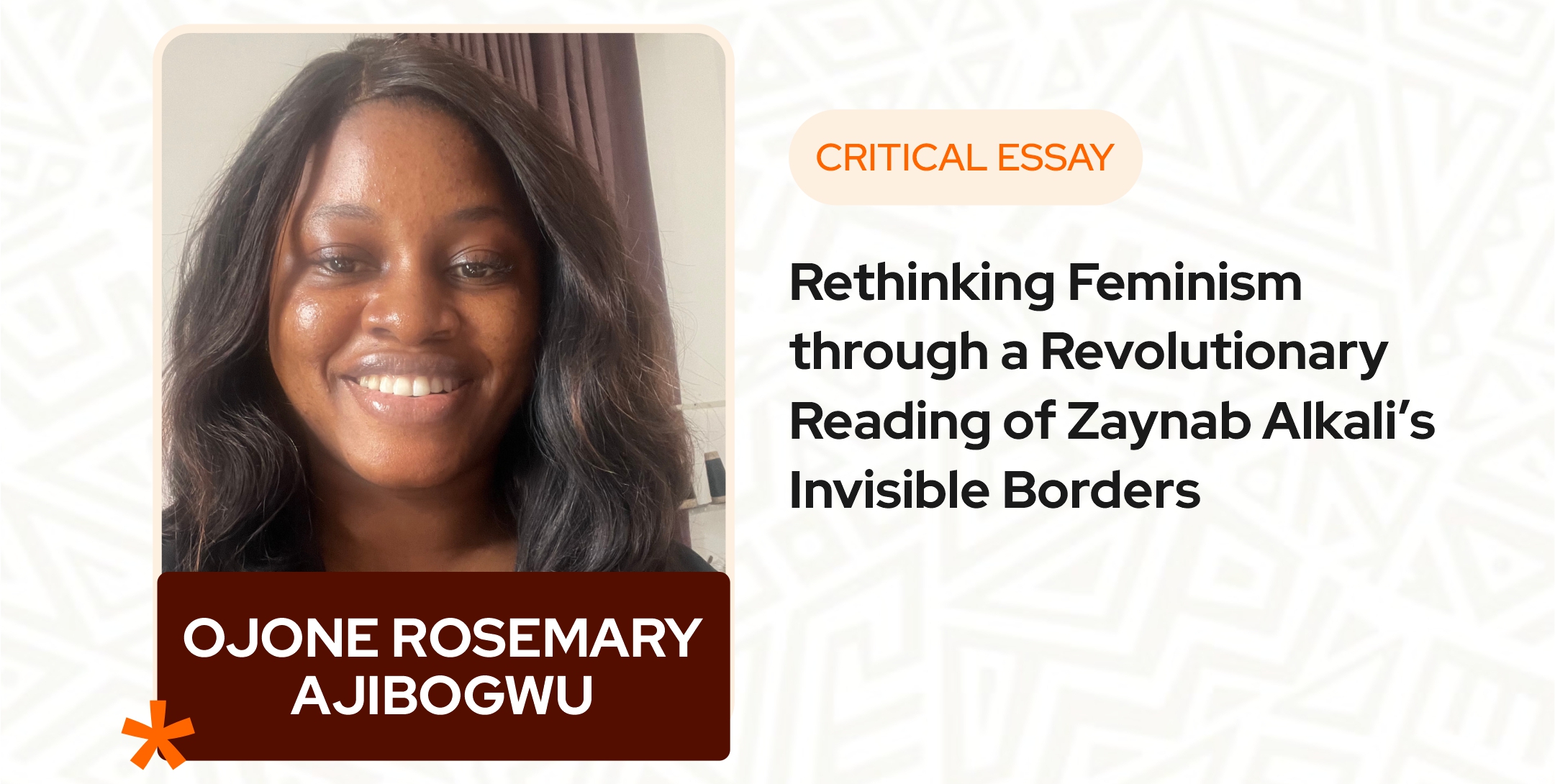
Ajibogwu, Rosemary Ojone PhD, is an academic who has applied herself in a number of ways in research. She believes in humanizing knowledge and advocates for revolutions in reading to account for current trends and evolving histories. She’s currently a lecturer with Bingham University Karu.