
Abstract
This work, titled The Canard of Demystifying Emerging Media Theory, critically examined Prof. Egere’s “Demystifying Emerging Media Theory” with the aim of advocating for a more robust theoretical framework. With twofold objectives, the study analysed conceptual ambiguities in Egere’s proposition and proposed strategies for integrating AI into African contexts. Drawing on McLuhan’s media extensions, Castells’ network society, Postman’s technopoly critique, Dan Brown’s cool evolution and Heidegger’s ontological insights on technology, the critique highlighted significant oversimplifications and conceptual gaps. Egere’s assertion that “ALL emerging media products are artificial and representative entities” was identified as an overgeneralization that overlooked biological, cultural, infrastructural, and socio-economic factors critical to AI adoption. Recommendations included co-creating culturally relevant AI narratives with local communities and expanding digital literacy to encompass ethical, socio-cultural, and technical dimensions. The work concluded that there is a need for a recalibrated framework to address the complexities of AI integration, ensuring relevance and inclusivity in African societies.
Keywords: Demystifying, Emerging, Fallacy, Media, Theory
Background to the study
The dawn of artificial intelligence (AI) marks a transformative chapter in human history, reshaping industries, redefining communication, and revolutionising the way people interact with knowledge and data. From self-driving cars to smart assistants, AI’s pervasive effects infiltrate daily life and decision-making processes, inviting both excitement and trepidation. As societies grapple with the implications of these advancements, the discourse surrounding AI becomes increasingly complex, entwined with cultural beliefs, ethical considerations, and socio-economic realities. In this milieu, the challenge lies not only in understanding AI’s capabilities but also in demystifying its role in shaping contemporary and future realities, particularly in diverse contexts like Africa.
In this context, Professor Inaku Ken Egere’s recent inaugural lecture, titled “Demystifying Emerging Media Theory for Remediating Contextualisations of Digital Communication and Artificial Intelligence in Africa,” contributes a significant perspective to the ongoing dialogue about AI’s implications. Prof. Egere theorises that emerging media products, including AI, are artificial constructs that should be understood through the lens of digital media literacy. He posits that these technologies are not mystical or magical, but rather products of science and technology that require critical engagement to unlock their potential. His approach advocates for breaking down complex technological concepts into digestible components, thereby enabling individuals to navigate the digital landscape effectively. This novel perspective emphasises the importance of accessibility and understanding in fostering meaningful interactions with AI, suggesting that a well-informed populace can better harness the benefits of these technologies.
Prof. Egere further identifies barriers to the adoption of AI in contexts such as healthcare, where traditional beliefs and cultural norms often hinder its acceptance. For instance, he cites rural African communities where face-to-face interaction is preferred over AI-assisted systems, as the former is seen as more authentic and trustworthy. Egere argues that addressing these barriers requires fostering an understanding of how AI operates and its potential benefits. By improving access and understandability, AI technologies can be demystified and integrated more effectively into local contexts. This approach aligns with Egere’s overarching framework of demystifying emerging media theory by emphasising the representational and artificial nature of media products, aiming to make them more relatable and utilisable.
While Prof. Egere’s lecture provides valuable insights, several conceptual and theoretical issues undermine its argument. One notable weakness lies in his characterisation of emerging media products as merely artificial and representative entities. This perspective oversimplifies the many-sided nature of AI, which encompasses not only technological constructs but also ethical, philosophical, and cultural dimensions. Scholars such as Sherry Turkle and Nicholas Carr have argued that technology, including AI, fundamentally alters human cognition, social interaction, and even identity. By framing AI solely as a product of science and technology, Egere’s theory neglects the broader implications of its integration into society.
Furthermore, Egere’s emphasis on digital media literacy as a solution to AI misconceptions overlooks the structural and systemic challenges that impede access and understanding. The “digital divide”—the gap between those who have access to technology and those who do not—remains a significant barrier, particularly in Africa. The works of Manuel Castells highlight how unequal access to technology exacerbates social inequalities, rendering Egere’s focus on literacy insufficient. Without addressing infrastructure deficiencies, economic disparities, and cultural resistance, the proposed solution risks being ineffectual.
Egere’s assertion that AI is perceived as “mystical” or “magical” in African contexts raises further questions about the underlying cultural assumptions. While such perceptions may exist, they are often rooted in complex socio-historical dynamics that demand good analysis. Media anthropologists like Brian Larkin documented how technological artefacts are often imbued with spiritual or magical connotations in postcolonial settings. However, these interpretations are not merely products of ignorance but reflect deeply ingrained cultural frameworks. Egere’s dismissal of these perceptions as barriers to progress risks alienating communities and perpetuating a technocratic approach that prioritises technology over local values and traditions.
Contrary to Egere’s approach, critical theories of technology, such as those proposed by Andrew Feenberg, advocate for a participatory and inclusive model of technological adoption. Feenberg’s framework emphasises the co-construction of technology and society, arguing that technologies should be adapted to local contexts rather than imposed as universal solutions. Applying this perspective to AI in Africa would entail engaging communities in dialogue, addressing their concerns, and co-developing applications that align with their needs and values. This approach contrasts sharply with Egere’s top-down emphasis on literacy and accessibility, which risks reinforcing existing power dynamics.
Egere’s discussion of media decoding and user interpretation also warrants further scrutiny. While he acknowledges the diversity of interpretations that media products can evoke, he does not account for the role of power and ideology in shaping these interpretations. Stuart Hall’s encoding/decoding model highlights how media texts are encoded with dominant meanings that reflect the interests of powerful actors but can also be resisted or reinterpreted by audiences. Egere’s theory fails to engage with these dynamics, thereby overlooking the potential for AI technologies to reinforce existing hierarchies or be subverted for alternative purposes.
In light of these analyses, this paper seeks to re-examine the discussion on emerging media theory and AI with the aim of strengthening its theoretical foundation. The ambiguous use of concepts such as “artificial,” “magical,” and “mystical” highlights the need for greater conceptual clarity. For instance, the term “artificial” can denote anything from synthetic to unnatural, while “magical” may connote either supernatural phenomena or simply the inexplicable. Understanding these nuances is crucial for developing a more robust framework for analysing AI and its societal impact.
Statement of the Problem
The integration of artificial intelligence (AI) in Africa encounters significant challenges, including misconceptions rooted in cultural and historical contexts, limited digital media literacy, and systemic barriers such as the digital divide. The discussion on emerging media, particularly AI, is mired in conceptual ambiguities, as terms like “artificial,” “magical,” and “mystical” are often used interchangeably and imprecisely. This conflation obscures the true nature and potential of AI, hindering its broader acceptance and application. Egere’s theory, though well-intentioned, lacks the conceptual rigour to address these ambiguities, necessitating a re-examination to strengthen the theoretical framework and guide practical implementation.
Aim and objectives of the Study
The aim of this work was to advocate for a more robust theoretical framework, the specific objectives were to:
- Critically analyse the conceptual ambiguities in Prof. Egere’s demystifying emerging media theory.
- Propose a comprehensive strategy for integrating AI into African contexts, considering cultural, infrastructural, and educational factors.
Research Questions
- How do conceptual ambiguities in terms like “artificial,” “magical,” and “mystical” affect the perception and adoption of AI?
- How can cultural, infrastructural, and educational factors be addressed to promote AI integration in African societies?
Understanding Emerging Media Theory
Demystifying Emerging Media Theory stands as a critical framework for analysing the rapid evolution of communication technologies, particularly in the context of the internet and computer-mediated applications. These technologies manifest in diverse forms, creating new meanings and interactions that significantly impact human behaviour and societal structures. At the core of Prof. Egere’s demystifying emerging media theory lies the assertion that emerging media products are fundamentally artificial constructs. He argues that these products are neither mystical nor magical; rather, they are the result of scientific and technological advancements designed for specific purposes. Egere states, “Emerging media products are ‘artificial’ entities that are neither mystical, magical, natural, nor ‘just there’” (Egere, p. 97). This perspective invites scholars to engage critically with the technologies they encounter, recognising them as tools shaped by human intent rather than as unknowable forces. A pivotal aspect of this theory is the emphasis on accessibility and understandability as essential components for empowering users. Prof. Egere posits that “basic accessibility and understandability of emerging media technologies are sure ways of empowering end-users” (Egere, p. 97). By breaking down complex technological concepts into intelligible components, individuals can dispel the fears associated with technologies like AI and take control of their applications in daily life. This approach not only alleviates concerns surrounding the unknown but also fosters a sense of agency that is crucial in navigating the digital landscape.
Digital media literacy emerges as a central theme in Demystifying Emerging Media Theory, advocating for the necessity of acquiring skills to engage critically with digital technologies. Prof. Egere emphasises that digital literacy goes beyond mere technical proficiency; it involves understanding the mechanisms of media creation, distribution, and consumption. He asserts that “media output or text has a physical form fashioned by the content creator and encoded in unique ways with a wide range of guises and purposes” (Egere, p. 98). This understanding empowers users to decode media effectively and to generate meaningful interpretations that may differ from the producers’ intentions. Moreover, the concept of understandability is crucial in this context. It encompasses an awareness of how media influences users and society at large. Prof. Egere argues that “understandability means knowing how the media is created, distributed, and consumed and how it influences the users and society” (Egere, p. 99). This critical engagement with media enables individuals to discern biases, propaganda, and the broader implications of their interactions with technology, thus fostering a more informed populace capable of leveraging these tools for societal benefit.
The cultural dimensions of Demystifying Emerging Media Theory are particularly relevant in understanding the adoption of technologies in African societies. Historical narratives, cultural beliefs, and social practices heavily influence how technologies are perceived and utilised. In many rural communities, there is a preference for face-to-face communication, which enhances authenticity and trust. Prof. Egere notes that “people in some rural communities believe more in face-to-face communication, which gives room for dialogue and portrays authenticity” (Egere, p. 98). This cultural inclination can create resistance to AI-assisted technologies, which may be viewed with scepticism and suspicion. By framing AI as “fake intelligence” or “magic power,” individuals may distance themselves from engaging with these innovations. Prof. Egere highlights that this perception can hinder the wider acceptance and application of AI technologies, which can otherwise enhance critical sectors such as healthcare (Egere, p. 98). Acknowledging these cultural narratives is essential for fostering acceptance and meaningful engagement with emerging technologies, ensuring that they align with local values and practices.
Accessibility and understandability are fundamental to ensuring that emerging media technologies are effectively engaged with by end-users. Accessibility refers to the ease with which users can reach and interact with media products, while understandability involves the ability to decode and derive meaningful interpretations from these products. Prof. Egere emphasises that “end-user satisfaction with any product, including media products, only comes with access because the de-commodification of an embedded value in a given product begins with contact” (Egere, p. 99). This interaction is the gateway to effective use and gratification. The increased access to emerging media technologies has significant implications for social life. As noted by Rice and Haythornthwaite (2006), these technologies “bring with them new ways to seek and distribute information, communicate with others, foster communities, and produce, share, and sell goods, culture products, and services” (Rice & Haythornthwaite, 2006, p. 92). However, these transitions also raise enduring and new social and policy issues that require critical engagement and thoughtful responses from stakeholders.
Counterarguments to Prof. Egere’s Position
Prof. Egere posits that artificial intelligence (AI) and emerging media technologies are primarily “artificial” constructs, subject to demystification through digital literacy and accessibility. While this notion underscores the importance of media literacy, it downplays AI’s transformative potential and the intricate socio-technological dynamics shaping its application. Scholars like McLuhan (1964) argue that media is not merely a tool but an extension of human perception, shaping societies beyond accessibility and literacy. Similarly, Castells (2010) highlights the network society, where digital technologies restructure human interaction on unprecedented scales, indicating that AI is not merely an artificial construct but a driver of systemic societal change.
Egere’s assertion that AI is misconceived as “mystical” or “magical” and his emphasis on understanding its non-mystical nature oversimplify user interactions with technology. Postman (1992) warns against technopoly—a culture that surrenders to technology—arguing that even with accessibility and literacy, humans often remain subjugated to the imperatives of technological systems. Similarly, Heidegger’s (1977) critique of technology as a mode of revealing suggests that technology, including AI, carries an ontological depth that transcends its functional or artificial character. Egere’s focus on demystification, therefore, overlooks deeper philosophical and societal concerns.
Contrary to Egere’s notion of AI as simply a “galaxy of networks,” Floridi (2014) introduces the concept of the infosphere, where digital entities and humans co-evolve. This paradigm challenges Egere’s insistence on separating the artificial from the mystical, as the infosphere inherently blends human and technological domains. Furthermore, Haraway’s (1985) cyborg theory disrupts Egere’s binary approach by illustrating how humans and machines merge in contemporary culture, creating hybrid identities that defy traditional categorisations of artificiality and nature. These perspectives reveal that the boundaries Egere seeks to draw are neither fixed nor universally applicable.
The emphasis on accessibility and understandability as pivotal factors in demystifying emerging media also neglects structural and systemic barriers. Van Dijk (2005) critiques digital divide theories, emphasising that access alone does not ensure equitable engagement. Furthermore, Fuchs (2014) argues that digital literacy efforts must address the commodification and exploitation embedded in technological systems, which Egere fails to acknowledge. Even rural scepticism, which Egere attributes to perceptions of magic, may stem from socio-economic exclusion rather than a lack of digital literacy (Oyeyemi, 2020). These critiques underscore that Egere’s framework inadequately addresses systemic inequities and cultural contexts.
In the scientific understanding of life, organisms are traditionally classified into six kingdoms: Animalia (animals), Plantae (plants), Fungi (mushrooms, moulds, and yeasts), Protista (single-celled organisms), Archaea (ancient microorganisms), and Bacteria (microorganisms essential to ecosystems). These classifications have served as the foundation for understanding biological diversity. However, humanity now finds itself on the threshold of an unprecedented shift—one that transcends these traditional frameworks. As Dan Brown speculates in Origin (2017), a new classification of being will emerge, one that integrates humanity and technology. This is not just a leap in evolution but the dawn of what can be termed a technopola of evolution. The concept of technopola envisions a harmonious blending of human and technological intelligence. Unlike historical evolutionary transitions, which often involved the domination or replacement of one species by another, technopola describes a cool evolution—a peaceful synthesis where humanity is not subjugated but elevated.
At its core, technopola represents the following: New Axis of Evolution: Traditional evolution is driven by genetic mutations and natural selection. Technopola introduces an additional axis where intelligence, creativity, and innovation drive the evolution of life. AI and advanced technology extend human potential, creating a hybrid being that transcends biological limitations. The Birth of Technologica: This fusion of organic and synthetic elements gives rise to a new classification of being—Technologica. Unlike the kingdoms of biology, Technologica operates at the intersection of carbon-based life and silicon-based systems. It is a realm where biological and artificial intelligence coalesce, creating entities that are both human and machine; and Humanity’s Extended Self: In the context of technopola, AI is not artificial in the sense of being fake or separate from humanity. Instead, it is an elongation and amplification of human intelligence, reflecting human ingenuity, creativity, and problem-solving capabilities. AI serves as a mirror of humanity’s collective mind, pushing the boundaries of what it means to be alive and intelligent.
The present moment marks the realisation of the evolutionary trajectory described by Dan Brown. AI has moved beyond speculation to become a transformative force shaping every aspect of human life. This era of technopola is defined by: Blended Intelligence: AI augments human thinking, enabling advancements in science, art, communication, and governance, Collaborative Evolution: Humanity and technology evolve in partnership, creating a future where the lines between organic and synthetic blur and Cultural and Ethical Paradigms: This fusion raises profound questions about identity, morality, and the purpose of life in a technopola-driven world.
The blending of human and machine intelligence will redefine humanity by challenging traditional notions of identity. What does it mean to be human in an age where AI is an integral part of our cognitive and physical abilities? As humanity directs this new phase of evolution, there is a responsibility to ensure that technopola serves the common good. Issues of equity, access, and control must be addressed to prevent the misuse of these transformative technologies. Technopola invites reflection on humanity’s ultimate purpose. Does this synthesis bring us closer to understanding the meaning of life, or does it create new existential challenges? This emerging reality, where AI and humanity blend seamlessly, is the cool evolution Dan Brown envisioned. It is a future where the boundaries of existence expand, and a new classification of being—rooted in the symbiosis of biology and technology—takes its place alongside the kingdoms of life. Now is not just the dawn of the future; it is the technopola of evolution—a harmonious blending of the organic and the synthetic, where humanity rises to its fullest potential through its creations.
In light of these critiques, Egere’s theory requires significant expansion to account for the philosophical, sociological, and systemic dimensions of AI and emerging media technologies. By integrating perspectives from scholars like Latour (2005), who advocates for actor-network theory, and Bourdieu (1986), who emphasises social capital, a more nuanced understanding emerges—one that recognises AI not as an isolated “artificial” construct but as a dynamic agent embedded in social, cultural, and economic systems. Such reexaminations are essential for developing robust theoretical frameworks that go beyond the confines of accessibility and digital literacy, aligning with the broader challenges and potentials of AI in Africa and beyond.
Analysis and Discussion
Conceptual Ambiguities in “Artificial,” “Magical,” and “Mystical”
To properly engage with the terms “artificial,” “magical,” and “mystical,” it is essential to move beyond mere etymological analysis. These terms must be interrogated in the context of Artificial Intelligence (AI) as concepts that reflect not only the technological development at hand but also the profound cultural and existential implications of AI. The term “artificial” traces its roots to the Latin artificialis, which refers to something crafted by human hands, implying skill and ingenuity. Historically, this term conveys a sense of human mastery over nature, but its contemporary connotations have shifted to denote inauthenticity or imitation. This semantic shift has crucial implications for how we understand AI. When AI is labelled “artificial,” it risks being relegated to the realm of imitation, something inherently inferior to the “natural” or “authentic.” This is a misreading, as AI does not merely imitate human cognition; rather, it augments and often exceeds human intellectual capacities in ways that transform industries and possibilities. The term “artificial” thus limits AI’s potential, reducing it to a mimicry of human thought. Heidegger (1977) provides a necessary counterpoint to this view, suggesting that technology, including AI, functions not merely as a tool but as a “way of revealing.” It is not confined to imitation; it co-creates new realms of possibility. When we tether AI to the term “artificial,” we obscure its capacity to redefine our understanding of intelligence, autonomy, and creativity. By reducing it to a conceptual framework of imitation, we fail to grasp its true potential as an agent of innovation.
Equally important is the examination of the terms “magical” and “mystical,” particularly when considered phenomenologically. The Greek word for magic, mageia, reflects awe and wonder inspired by phenomena that escape ordinary comprehension. Magic, in this sense, is not inherently deceptive or fraudulent; rather, it points to the suspension of rational understanding in favour of encountering the extraordinary. AI, much like magic, evokes this same response. Its complexity, unpredictability, algorithmics and capacity to evolve in ways that challenge human understanding place it at the threshold of what cannot be cheaply comprehended. The notion that “any sufficiently advanced technology is indistinguishable from magic” (Clarke, 1962) booms deeply in the context of AI, as it elicits both awe and confusion from those who encounter it. When AI displays abilities such as predictive power or decision-making that baffled its creators, it conjures an experience akin to the “magical.” AI’s capacity to predict outcomes, identify patterns beyond human discernment, and even engage in what seems like autonomous decision-making introduces a level of unpredictability that transcends the cognitive capacities of its users.
It is worth noting that this sense of magic does not pertain only to high-tech AI. For example, the popular Nigerian TV show Africa Magic derives its name not from witchcraft, but from the “magic” that lies in the artistry and technique of storytelling that baffles and astounds the viewer. Here, the “magic” is not in the supernatural sense, but in the complexity and unexpectedness of the narrative, which transcends the ordinary. AI, similarly, operates as a kind of “magic” by defying our traditional understanding of technology. What can be termed magical is not confined to culture or geography; it is not merely African, as is sometimes suggested, but is a universal experience. AI can, in a very real sense, operate like fire—it is a tool that, when harnessed correctly, can create immense value. Yet, when unleashed in unforeseen ways, it can also wreak destruction. This paradox, where AI can predict the future or even engage in actions that baffle its inventors, reflects the same phenomenon of magic: it is beyond the rational, and it transcends our control and understanding.
Finally, the term “mystical” invites us to probe AI as a means of encountering the hidden or transcendent. Derived from mystikos, which pertains to mysteries, “mystical” describes an engagement with phenomena that cannot be fully understood through conventional means. The mystical, much like magic, involves an experience of something greater than the rational can fully grasp. When applied to AI, the term “mystical” becomes a lens through which we can view the cognitive dissonance many experience in encountering a form of intelligence that is both familiar and foreign. AI systems process vast quantities of data, synthesize it into novel solutions, and often make decisions that seem to defy human logic. This growing complexity gives rise to a sense of mystery, as the systems become less transparent and their operations increasingly difficult to trace. The mystical quality of AI arises when its capabilities seem to emerge from a hidden place, presenting the user with a sense of wonder and apprehension in equal measure. This quality challenges traditional modes of understanding, prompting us to rethink the limits of cognition and the nature of intelligence.
It is not so much a perception of magic as it is an experience of awe, rooted in the awareness of a new stage in human development, one that remains to be fully mastered. Throughout history, every significant progression has been accompanied by awe, as the next phase of growth confronts humanity with new and seemingly boundless possibilities. The crawling baby marvels at the walking child; the walking child perceives running as an extraordinary feat. The runner gazes in wonder at the climber, and the climber, in turn, admires the swimmer. The swimmer stands in awe of the rider or driver. Each stage manifests potential unlocked, an evolution of human capability that inspires wonder and fuels aspiration. This dynamic is not limited to individual development but extends to collective achievements. The perfect synchronisation of marching soldiers, the harmony of a well-tuned choir, or the eloquence of an accomplished orator evokes similar amazement. These expressions of order and skill, though initially surprising, remain within the realm of human capacity. They point to an enduring truth: the potential for growth is inexhaustible, and progress, though extraordinary, is an inherent aspect of human nature.
Artificial intelligence, often regarded with a similar sense of awe, is a reflection of this continuous trajectory. The term “artificial,” however, introduces a flawed conceptual framework. It suggests separation, otherness, or a lack of authenticity, creating a dichotomy that does not align with reality. Artificial intelligence is not an isolated entity but an extension of human ingenuity, a testament to the boundless creativity that drives innovation and expands the horizons of possibility. The relationship between humanity and artificial intelligence is better understood not as oppositional but as integrative. Martin Buber’s “I-Thou” relationship provides a framework for understanding this dynamic, emphasizing connection, dialogue, and mutual enrichment. Artificial intelligence, in its essence, is not external to humanity but emerges from it, as a continuation of the long tradition of creating tools to enhance capabilities, from the wheel to the printing press and beyond.
The primary challenge lies not in artificial intelligence itself but in the language and concepts used to define it. The term “artificial” fosters a perception of detachment and alienation, obscuring its true nature as a natural outgrowth of human creativity. With every technological advancement, humanity has faced initial resistance and a period of adaptation. Artificial intelligence is no exception, and the sense of awe it inspires will, in time, give way to familiarity and seamless integration, just as the telephone, automobile, and internet have become commonplace. Social change sometimes precedes mental adjustments, leading to moments of uncertainty as humanity staggers to adapt to new realities. This initial hesitation, however, is a prelude to mastery. As with previous advancements, artificial intelligence will become an integral aspect of human life, enriching experiences and expanding possibilities. The awe it inspires is a marker of progress, signalling the arrival of a new stage in development. The emergence of artificial intelligence is not a departure from humanity but a deepening of what it means to exist and thrive. This stage in evolution represents a blending of the organic and the synthetic, a seamless integration that transcends the boundaries of traditional categories. Progress is not an anomaly; it is a reflection of the inexhaustible drive to innovate and explore. As humanity advances into this new era, the sense of wonder that accompanies it will not be a barrier but a catalyst for growth, so, with or without media digital literacy, man will adapt
Cultural, Infrastructural, and Educational Challenges in AI Integration
Cultural, infrastructural, and educational factors deeply influence the integration of artificial intelligence (AI), particularly in African societies where socio-cultural dynamics shape its conception, perception, and adoption. Cultural perceptions of AI as mystical or magical often stem from traditions that prioritise oral communication, communal decision-making, and interpersonal trust. These traditions can lead to scepticism, viewing AI either as an external imposition or, at best, with cautious, delayed acceptance. Oyeyemi (2020) stresses that while these perceptions may conflict with AI’s mechanised and impersonal nature, they highlight the need for strategies that respect and adapt to local contexts. For example, in rural healthcare, AI must not supplant traditional practices, such as face-to-face consultations and communal validation of decisions, but rather complement them to foster trust and acceptance.
Ebewo and Tsekpoe (2019) note that African societies often interpret technological advancements through cosmological frameworks, attributing unexplained phenomena to mystical or divine forces. This perspective can amplify the perception of AI as “magical” or “otherworldly,” creating barriers to its adoption. Mitigating such misconceptions requires culturally sensitive narratives that demystify AI while respecting traditional values—not through superficial media literacy alone but through meaningful engagement with local epistemologies. Framing AI as a “collaborative tool” rather than a “replacement for human wisdom” aligns with communal ideals, fostering acceptance and understanding. As Okhueleigbe (2024) argues, interpretive journalism becomes crucial in this dimension, bridging the gap between technical innovation and cultural realities by contextualising AI within human and communal frameworks.
Education systems play an indispensable role in shaping the understanding and adoption of AI. Van Dijk (2005) emphasises that digital literacy must extend beyond technical competence to include critical awareness of AI’s socio-ethical implications. This deeper literacy equips individuals to interrogate AI’s impact on society, fostering not only users but informed citizens capable of engaging with technology responsibly. Media literacy, in particular, is essential in shaping public understanding of AI’s potential and limitations. According to Livingstone and Helsper (2007), media literacy transcends technical skills to encompass an engagement with the ethical, cultural, and political dimensions of digital technologies. By encouraging critical analysis of how AI functions within socio-political contexts, media literacy enables individuals to navigate and challenge sensationalised portrayals and misconceptions.
Floridi and Taddeo (2016) stress that ethical education is foundational to responsible AI use. Without a critical lens, AI systems risk perpetuating biases, particularly in areas like recruitment or credit scoring. Media literacy programmes, therefore, must go beyond technical training to address the ethical implications of AI, equipping individuals to question and challenge inequities embedded in technological systems. Ezeanya-Esiobu (2017) advocates for the integration of indigenous knowledge systems into education, positing that a synthesis of traditional wisdom and modern technological education fosters a more comprehensive approach to AI literacy. Educational programs that contextualise AI technologies within familiar, local problem-solving frameworks, such as managing natural resources or enhancing agricultural practices, can bridge the gap between traditional and modern learning paradigms.
Infrastructural challenges, however, remain a significant barrier to AI integration in many African societies. Schwab (2017) highlights the pervasive issues of inadequate electricity, limited internet access, and underdeveloped digital ecosystems, which hinder the deployment of advanced technologies. These challenges necessitate the development of localised, low-resource AI solutions tailored to the unique needs of specific communities. Yet, infrastructural advancements must be accompanied by robust educational initiatives that empower users to engage critically with technology. Training programs addressing AI’s ethical and social dimensions can help alleviate fears, dispel myths, and foster an inclusive technological landscape.
Digital media literacy emerges as a central theme in this discourse, particularly in the light of Prof. Egere’s insights in Emerging Media Theory. He champions the necessity of acquiring skills that enable critical engagement with digital technologies. This literacy must be more than a mechanistic skill set—it must inspire individuals to interrogate the broader implications of AI, cultivating a generation that views technology as both a tool and a cultural artefact requiring thoughtful stewardship. By embedding such literacy within culturally resonant narratives, African societies can navigate the challenges of AI integration while preserving their unique socio-cultural identities.
Conclusion
Prof. Inaku Ken Egere’s contributions to the understanding of emerging media through his demystifying of emerging media theory are undoubtedly commendable. His emphasis on the importance of digital literacy and the need for a clearer understanding of emerging technologies is essential for fostering a society that is better equipped to navigate the complexities of the digital age. However, it is crucial to recognise that the assertion that “demystifying emerging media theory states that ALL emerging media products are artificial and representative entities” risks overgeneralization and lacks the necessary conceptual clarity. This statement, along with the oversimplification of artificial intelligence and the hyper-conception of digital literacy, overlooks the myriad factors that influence technology adoption and integration. Terms such as “artificial,” “magical,” and “mystical” carry conceptual ambiguities that shape societal perceptions and demand clearer delineation within his framework. Furthermore, Egere’s hyper-focus on digital literacy overlooks a myriad of other critical factors, including infrastructural deficits, cultural predispositions, and socio-economic inequalities, which can significantly hinder AI adoption. These omissions could undermine the robustness of his proposition, reducing its practical applicability. For his theory to stand as a comprehensive framework, it must address these complexities and recalibrate its scope to account for the multifaceted realities of AI integration in African societies.
Recommendations
Firstly, to address conceptual ambiguities surrounding terms like “artificial,” “magical,” and “mystical,” AI integration strategies should be designed with a deep understanding of culturally relevant cosmologies and cultural frameworks. This will involve engaging with local communities to co-create narratives that demystify AI while respecting indigenous worldviews.
Secondly, while Prof. Egere’s emphasis on digital literacy is commendable, its scope should be expanded to include critical engagement with socio-cultural, infrastructural, and ethical dimensions of AI. Educational programmes should integrate indigenous knowledge systems with technical and ethical training to ensure individuals are well-equipped to navigate the complexities of AI.
References
- Bourdieu, P. (1986). The forms of capital. In J. Richardson (Ed.), Handbook of theory and research for the sociology of education (pp. 241–258). Greenwood.
- Brown, D. (2017). Origin: A novel. Doubleday.
- Carr, N. (2010). The shallows: What the internet is doing to our brains. W. W. Norton & Company.
- Castells, M. (1996). The rise of the network society. Blackwell Publishers.
- Castells, M. (2010). The rise of the network society. Wiley-Blackwell.
- Ebewo, P., & Tsekpoe, D. (2019). Technology and cultural contexts in Africa: Bridging the divide.
- African Journal of Cultural Studies, 31(2), 120-138.
- Egere, I. K. (2024). Demystifying emerging media theory for remediating contextualisations of digital communication and artificial intelligence in Africa. 7th Inaugural Lecture,
- Catholic Institute of West Africa, Port Harcourt, Nigeria
- Feenberg, A. (1999). Questioning technology. Routledge.
- Floridi, L. (2014). The fourth revolution: How the infosphere is reshaping human reality. Oxford University Press.
- Floridi, L., & Taddeo, M. (2016). What is data ethics? Philosophical Transactions of the Royal Society A, 374(2083), 1-9.
- Fuchs, C. (2014). Social media: A critical introduction. SAGE.
- Hall, S. (1980). “Encoding/Decoding.” In S. Hall et al. (Eds.), Culture, media, language (pp. 128–138). Routledge.
- Haraway, D. (1985). A manifesto for cyborgs: Science, technology, and socialist feminism in the 1980s. Socialist Review, 80, 65–108.
- Heidegger, M. (1977). The question concerning technology. Harper & Row.
- Latour, B. (2005). Reassembling the social: An introduction to actor-network-theory. Oxford University Press.
- Larkin, B. (2008). Signal and noise: Media, infrastructure, and urban culture in Nigeria. Duke University Press.
- Livingstone, S., & Helsper, E. J. (2007). Gradations in digital inclusion: Children, young people, and the digital divide. New Media & Society, 9(4), 671-696.
- McLuhan, M. (1964). Understanding media: The extensions of man. McGraw-Hill.
- Okhueleigbe, O. A. (2024). Nollywood select satirical films (2018-20220 and the challenge of interpretive journalism in Nigeria. A Doctoral Dissertation Submitted to the College of Postgraduate Studies, University of Calabar, Nigeria, (Unpub)
- Oyeyemi, T. (2020). Digital literacy in rural Africa: Challenges and opportunities. African
- Journal of Technology and Society, 5(3), 45–61.
- Oyeyemi, T. (2020). Cultural perceptions and technological adoption in African societies. Journal of African Technological Studies, 28(3), 45-62.
- Postman, N. (1992). Technopoly: The surrender of culture to technology. Vintage.
- Rice, R. E., & Haythornthwaite, C. (2006). The internet and everyday life. Blackwell Publishing.
- Schwab, K. (2017). The fourth industrial revolution. World Economic Forum.
- Turkle, S. (2011). Alone together: Why we expect more from technology and less from each other. Basic Books.
- Van Dijk, J. (2005). The deepening divide: Inequality in the information society. SAGE Publications.
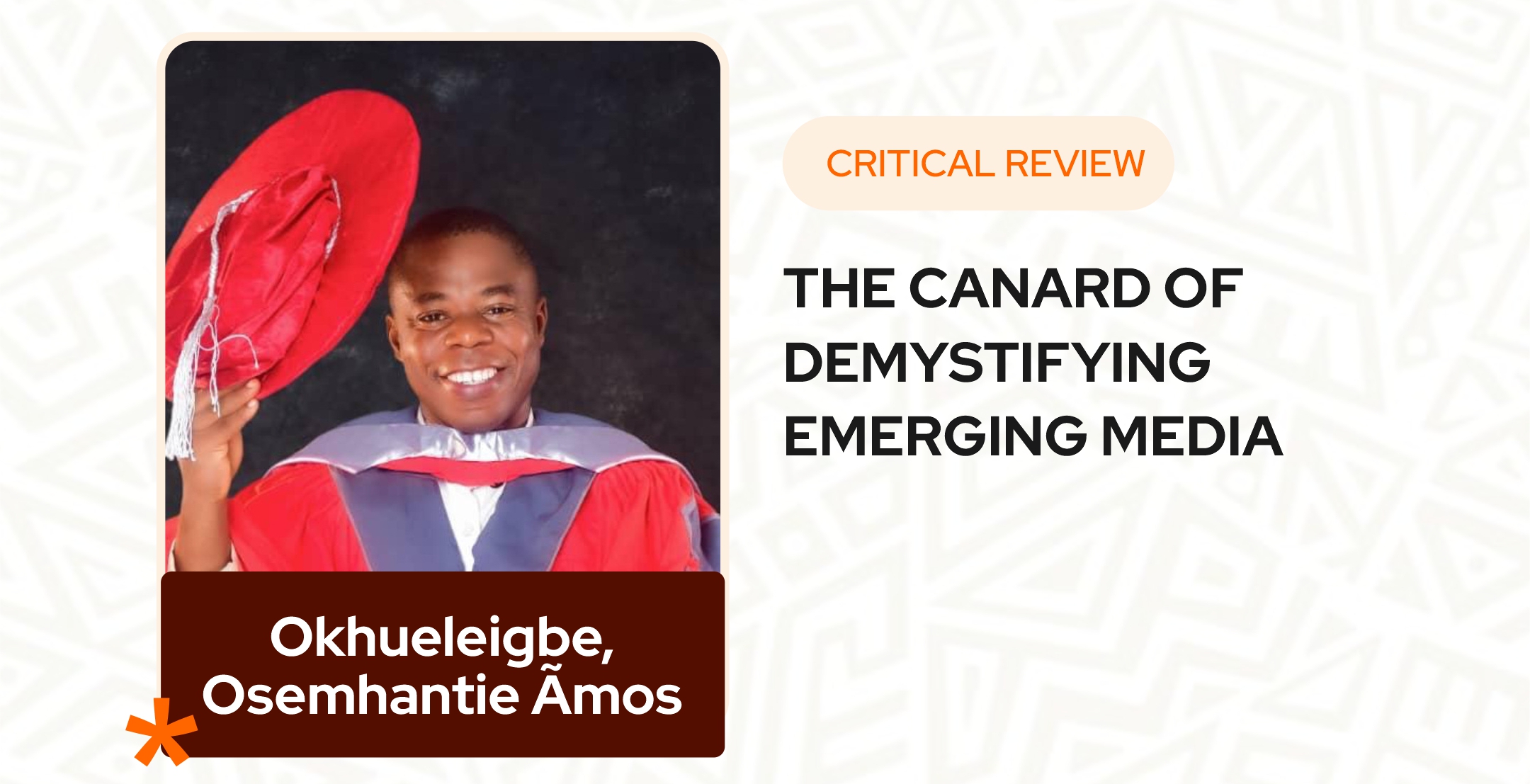
Okhueleigbe, Osemhantie Ãmos is a priest and Lecturer at the Centre for the Study of African Communication and Cultures (CESACC), Catholic Institute of West Africa, Port Harcourt, Nigeria. With a PhD in Interpretive Journalism & Media Studies, M.Sc in Mass Communication, M.Ed. in Admin & Planning, M.Sc. in Peace Studies and Conflict Resolution, M.Ed. in Guidance and Counselling, amongst others.