
Abstract
This review examines Nigerian literature as a dynamic force for social transformation, foregrounding how writers have articulated dissent, reshaped collective consciousness, and mobilised ethical debate across historical periods. Drawing on selected novels, plays, poetry, and essays from the pre-colonial era to the present, the study traces how literary voices interrogate power, expose inequality, and negotiate identities shaped by orality, colonialism, military rule, corruption, gender politics, and globalisation. It argues that Nigerian writers function not merely as observers but as cultural activists whose narratives generate empathy, preserve memory, and imagine alternative social futures. Through thematic and contextual analysis, the review highlights literature’s role in amplifying marginalised voices, contesting dominant ideologies, and fostering civic engagement. By situating Nigerian texts and writers within broader African and global discourses of resistance, the article demonstrates how literature operates as a catalyst for social change, sustaining dialogue between art, society, and transformative action nationwide.
Introduction
In life, humans are renowned for experiencing both successes and failures. These have been enduring and unchangeable traits of humanity. History has documented these achievements and shortcomings at individual, group, national, and global levels. Throughout the ages, literature has served as a mirror of these experiences, fostering empathy and revisiting them through its three genres: poetry, prose, and drama (Tamás, 2020). In doing so, literature becomes both a recorder and a repository of human triumphs and failures (Baron, 2023). In this repository, humans are active participants, recorders, and voices of human (mis)behaviours. This allows us to trace the word “Literature” back to its Latin root, litteratura or literatura, derived from littera (meaning letter/writing) (Korenjak, 2023). Literature has been a part of humanity since its beginnings, from ancient oral traditions exemplified in folktales, legends, myths, poetry, drama, and more. These can be seen in enduring works such as Homer’s Iliad and Odyssey (c. 18th century BCE), the Sumerian Epic of Gilgamesh (c. 2100 BCE), the Egyptian Pyramid Texts (c. 2400 BCE), and the Yoruba Ifa Oracular Stories (c. 1000 BCE).
Defining Literature is simple but difficult. Simple in the sense that it can be said to be anything written, said, spoken, or recorded which has embedded in it intellectual, traditional, artistic or creative signs (Maritain, 2023). On the other hand, studies have shown that Literature is more than the above, and its definition can be approached from different perspectives. It can be viewed from the critical, functional, and academic definitions (McLaren, 2023: 75-97). But running through all like an unending but useful thread would be issues like themes, culture, tradition, written and or spoken works, communication, human experiences, emotions, aesthetics, literary devices, societal influence, social change, etc. (the last two as the focus for this paper).
Literature, from its beginning, and at different times, has been used for various issues in different cultures and traditions (Bagby, 2022). But not minding the place, time, and culture, Literature has come to serve general but very specific functional purposes: entertainment, educational, aesthetic, moral, ethical, cultural, psychological, emotional, historical, cognitive, intellectual, social, and political. These, in one way or another, run the gamut of human life. It might, therefore, be safe to posit that literature is a mirror of life (Ahad, 2020).
Over time, Literature has become an engaging tool and force in changing and transforming societies through its genres. Norms, beliefs, and ways of life are challenged, upheld, changed, reformed, remodelled, and affected through writings, songs, plays, poems, storytelling, drama, dances, novels, etc. These are creatively composed by writers, songsters, playwrights, poets, storytellers, dramatists, dancers, novelists, etc.
Life and Literary Changes
A major way Literature affects change is the exposure of societal struggles and inequalities. It can also be used to maintain the status quo. It seeks to maintain societal balance. It is a tool that can be utilised for both the negative and the positive (Bin-Nashwan, 2023). With Literature, no matter how negative the situation, the positive always wins, especially that which adds to the upward development of man. We might remember that the Holy Bible was used by the Dutch Reformed Church to establish and support the apartheid system in South Africa but dances, songs, novels, plays and poems were used in the struggle to fight and end it (Alan Paton’s Cry, the Beloved Country, Peter Abraham’s Mine Boy, Nadine Gordimer’s July’s People, Athol Fugard’s Sizwe Bansi is Dead, Nelson Mandela’s Long Walk to Freedom, etc).
Literature has helped to create new sociological traditions, values, and cultural norms. Through literary works, humans are introduced to new belief systems, and man, through these, becomes better. The ideas of gender equality, female freedom and feminism have been pushed through literary works like J.P. Clark’s The Wives Revolt, Buchi Emecheta’s Second Class Citizen, Nawal El-Saadawi’s Woman at Point Zero and Chimamanda Ngozi Adichie’s We Should All Be Feminists. One of the defining books on Feminism and its theory is Simone de Beauvoir’s The Second Sex (1949).
With Literature, one becomes a critical thinker (Alsaleh, 2020). Societal debates, engagements and critical thinking are encouraged. Society can develop thinkers in every aspect of its life. This is usually the foundation of the development of any society. A society without thinkers is bound to fail, and no society can develop more than its thinkers (Campbell, 2024: 35-68). In this way, a society’s educational sector is represented by its teachers, lecturers and scientists. Plato’s The Republic (c. 375 BCE) is a philosophical dialogue that examines the nature of reality, justice, politics, governance, etc. From this work came the popular “Allegory of the Cave,” which makes us re-examine truths at different but deeper levels. Charles Darwin’s The Origin of Species (1859) challenged how we once saw creation and man’s position in the universe. George Orwell’s 1984 (1949) prophesies man’s development and the danger of totalitarianism through surveillance, propaganda, and selfishness.
From the onset, Literature has been a voice for revolutionaries, revolutions, and their movements and ideologies (DeFronzo, 2021). In this, all the genres of literature have been used as tools for the conviction and confusion of people, resistance, movements, creation and counter-creation of ideologies. There is Karl Marx’s The Communist Manifesto (1848), which is the foundation of the socialist ideas that helped make Russia great, but which led to the deaths of millions. Poets are also not left out: Pablo Neruda (1904 -1973) wrote Canto General which portrayed the sufferings of Latin Americans, Christopher Okigbo’s (b.1932-d.1967) Labyrinth is about socio-political and religious changes, Niyi Osundare (b. 1947)’s Songs of the Marketplace examines corruption, societal inequalities and injustices while Langston Hughes’ (b.1902-d.1967) The Negro Speaks of Rivers discusses social limitations based on American racism.
In different traditions and cultures, Literature and its genres became the tools of the voiceless, the marginalised, the rejected, the condemned, the rejected, and the forgotten (Bencheriet, 2021). In all aspects of man’s development, those who have been deemed to be different from the accepted norms have always been punished for their difference. The saving tool for such has been Literature in all its forms. Literature becomes the avenue to share their experiences, record their sufferings, attract empathy, solicit understanding, and activate activism. Ken Saro-Wiwa’s Sozaboy discusses the problems of the ordinary people caught in the Nigerian Civil War, while Ngugi wa Thiong’o’s Weep Not Child (1964) engages the Mau Mau insurrection against colonial rule in Kenya.
From the foregoing, it can be deduced that people go through oppression and injustice. And these come from leaders at all levels and aspects of life: ethnic, religious, governmental, national, sub-national, social, political – name it. As long as there is hierarchy, division, separation, and differences, there will always be injustice and oppression. Literature becomes a mitigating and propaganda tool used in fighting, ameliorating, advocating, and correcting these myopic beliefs and behaviours known to wreak havoc wherever they occur (Eadon, 2024). Writers, advocates, propagandists, activists and others have written about these. Harper Lee’s To Kill A Mockingbird (1960) discusses injustice and inequality in the American South through the experience of a falsely accused Blackman. Aleksandr Solzhenitsyn’s One Day In The Life of Ivan Denisovich (1962) examines labour camps and oppression during Stalin’s rule in Russia. Khaled Hosseini’s The Kite Runner (2003) discusses Afghanistan’s Taliban oppression and refugees’ suppression and struggles as one of the outcomes of their rule.
As posited earlier, Literature is a mirror of society and even of life itself. It reflects and refracts (Adorno, 2020). It depicts and symbolises the different aspects of life as lived by people. Though it does not take sides as a recorder of happenings as they occur, in the long run, as proven by time, happenings, recordings and history, it is always on the side of the positivity of man as it helps him to develop holistically. It does not limit itself to negativity, though once in a while, it is mired in the baseness of humanity.
Nigerian Perspective, Reality, and Effect
Before the reality of the Nigerian nation, some state-nations flourished, but their existence was cut short by the destructive incursion of the Western world, internal strife, and wars. Some of these include Benin, Oyo, Mali, and Songhai empires. A few empires overcame the problematic 18th and 19th centuries and became part of Nigeria’s geographical metamorphosis, including Abeokuta, Sokoto, Oyo, Ilorin, Bornu, and Zaria.
In the above world, Literature, at the level of orality through myths, folktales, stories, dances, songs, etc, played a great role. Orality is the transmission of communal experiences through the spoken language. Here, the concern is with all aspects of a people’s life: history, origin, day-to-day, belief system and knowledge, science, religion, culture, tradition, etc. Transmission is verbal; it is memory-based, performance-biased, community-concerned, and very flexible with adaptability built into it. Griots officially transmit stories in Africa.
Oral elements as utilised by griots who transmuted from the world of orality to the written form include proverbs (Chinua Achebe), folktales and myths (Amos Tutuola), call and response (Wole Soyinka), songs and chants (Femi Osofisan and Stephen O. Solanke), and storytelling cadence and repetition (Cyprian Ekwensi). Within the old narrative and usage, there are the Ozidi Saga, the Moremi story, Udje dance, the Ijala poetry, the epic of Sunjata, etc. They were used to record communal happenings and to correct societal ills.
In the modern Nigerian world filled with national developmental problems, Literature has been playing its part from the 19th century to the present. This starts with Olaudah Equiano’s The Interesting Narrative of the Life of Olaudah Equiano, or Gustavus Vassa, the African (1789). He was an Igbo-Nigerian captured within the Igbo land and transported to America as a slave. His autobiography, which records the traditions of the then unnamed and unformed Nigeria, is documented as the first published by anyone referred to as a Nigerian.
The functions of writers and Literature are intertwined. These can be classified into different categories. Nigerian writers have expressed themselves in all the functions. Generally, Nigerian writers have put themselves in the line of duty, serving as catalysts and voices of change towards societal change and upliftment. They have served as chroniclers of history while rejecting colonial presence and oppression (Solanke, 2013). Both Chinua Achebe’s Things Fall Apart and Wole Soyinka’s Ake: The Years of Childhood reflect fictional and autobiographical pre-colonial, colonial, independence and post-independence Nigeria.
One other function of literature served by Nigerian writers is the examination of corruption, bad leadership, and their crippling effects on the nation’s growth at all political and leadership levels (Onyenweaku, 2024: 9-16). Chinua Achebe’s A Man of the People and Wole Soyinka’s The Man Died are depictions of these. They have not only written against societal ills, but they have also continued to proffer solutions to various societal limitations. Some of them have even been imprisoned because of their activism, political views, opinions and literary works: Wole Soyinka (1967-1969), Ken Saro-Wiwa (imprisoned 1994-1995 and executed in 1995), Nnamdi Azikiwe (1940s), Obafemi Awolowo (1963-1966), etc. A few faced threats and even went into self-exile: Niyi Osundare, Chinua Achebe, etc. They continue, through Literature, to be tools for resistance, social change, and development at the peril of their freedom and lives.
As catalysts towards positive national growth and development, Nigerian writers have become voices of change advocating for democracy and its continuance (Utoro, 2023). This has been done through poems, plays, and novels. This fight helped to bring back democracy into the Nigerian governance system. The struggle is to continue to maintain its presence. With this, human rights become a major factor. Okey Ndibe’s Arrows of Rain (2002), Chido Onumah’s We Are All Biafrans: A Participant-Observer’s Intervention In A Country Sleepwalking To Disaster (2016), Reuben Abati’s The Jonathan Years: A Memoir of the Presidency (2016) and Pius Adesanmi’s Naija No Dey Carry Last: Thoughts on a Nation in Progress (2015) all discuss the political, economic, social and governmental aspects of Nigeria.
The Nigerian literary world and its writers have also been involved in the following functions:
- Critiquing the female’s participation in family, communal and national development through the examination of women, gender, equality, and injustice, e.g. Chimamanda Adichie’s We Should All Be Feminists.
- Examining ethnic, sub-national, religious, and educational issues, e.g. Helon Habila’s Waiting for an Angel, and Sefi Atta’s Everything Good Will Come.
- Fighting and challenging norms, traditions, and injustices so that new ways of life that are humane and acceptable can be put in place, e.g. Chigozie Obioma’s The Fishermen and Teju Cole’s Open City.
- Advocating and promoting cultural and traditional values beneficial to society, e.g. Ben Okri’s The Famished Road and Stephen O. Solanke’s Alaafin Aole Arogangan.
From the above, it can be posited that Nigerian literary voices, through the genres of Literature, have been catalysts towards societal changes at all levels. They have not been found wanting. They have done all the above at the peril of their lives and limbs. In the past, their influence was felt. In the present, they are still a force to be reckoned with as they continue to add their quota, through their literary outputs, to the development of the Nigerian nation.
Future Perspectives
It has been established that Literature, through its different avenues, has played a vibrant part in developing man (Kennedy, 2022). But, as it is always said, there are always spaces to be filled or covered.
In Nigeria, Literature and Nigerian writers might need to become more concerned and act as voices and brokers of change in the following areas:
- Corruption and governmental accountability
- Insurgency, insecurity and kidnapping
- Gender rights and inequality between the genders
- The marginalised, the poor and the common people
- Youth development and empowerment
- Climate change and environmental problems
- Extremism at political, religious, ethnic, subnational, and national levels
On the global level, while some of the above are relevant, Literature and its creatives can be voices for the following issues. We must remember that Literature never takes sides: it is a tool to be used as seen fit by the writers, the audience and readers (the users and the receivers).
- Wars and displaced people or refugees
- Ethnicism, racism and related injustices
- LGBTQ+ and their rights
- Human rights and political oppression
- Class struggle and economic imbalances
That one belongs to the Literary and Debating Club, or Association gives one an edge over others in the field of Writing. One already has a literary-biased mind. Any of the above thematic issues can be examined through dance, songs, stories, plays, novels, and poems, as one writes about them for societal change. One can become an advocate of any one of them. There is no age limitation or barrier. All is towards humans having a beautiful and worthy universe to live in.
Conclusion
Literature has been a voice and a tool used by creatives, writers and others over time and across the globe as a catalyst towards societal change and development. This is a major function of Literature.
Based on our discussion, Literature has been shown to serve society from the time of orality to its present written genres of poetry, prose, and drama. Through them, traditional griots and modern writers have expressed old and new opinions, ideas, ideologies, and propaganda while affecting societal belief systems, attacking societal ills and proffering new pathways for their societies. Literature in Nigeria is playing its part in the ongoing development of the Nigerian nation. Though the creatives have faced persecution, they continue to be catalytic voices towards social change and development in their country, just like other writers and users of Literature around the world.
Works Cited
- Adorno, Theodor. Minima Moralia: Reflections from damaged life. Verso Books, 2020.
- Ahad, Md Nurul. ‘Mirroring Lamp’: The transcendental basis of romantic poetics. Clark University, 2020.
- Alsaleh, Nada J. “Teaching critical thinking skills: Literature review.” Turkish Online Journal of Educational Technology-TOJET 19.1 (2020): 21-39.
- Bagby, Philip. Culture and History: Prolegomena to the comparative study of civilisations. University of California Press, 2022.
- Baron, Naomi S. Who wrote this?: How AI and the lure of efficiency threaten human writing. Stanford University Press, 2023.
- Bencheriet, Fatna Marwa, and Azzeddine Bouhassoun. Voicelessness and Gender in Etaf Rum’s A Woman is No Man. Diss. University of Ain Temouchent, 2021.
- Bin-Nashwan, Saeed Awadh, Mouad Sadallah, and Mohamed Bouteraa. “Use of ChatGPT in academia: Academic integrity hangs in the balance.” Technology in Society 75 (2023): 102370.
- Campbell, Donald T. “The experimenting society.” The experimenting society. Routledge, 2024. 35-68.
- DeFronzo, James. Revolutions and revolutionary movements. Routledge, 2021.
- Eadon, Yvonne M., and Stacy E. Wood. “Combating contamination and contagion: Embodied and environmental metaphors of misinformation.” Convergence (2024): 13548565241255347.
- Kennedy, Hugh. The Prophet and the age of the Caliphates: The Islamic Near East from the sixth to the eleventh century. Routledge, 2022
- Korenjak, Martin. Latin Scientific Literature, 1450-1850. Oxford University Press, 2023.
- Maritain, Jacques. “Creative intuition in art and poetry.” (2023): 1-456.
- McLaren, Peter. “Critical pedagogy: A look at the major concepts.” The critical pedagogy reader. Routledge, 2023. 75-97.
- Onyenweaku, O. “Roles and Challenges of Literary Writers in a Corrupt and Insecure Society: The Nigerian Experience.” Indiana Journal of Arts & Literature 5.4 (2024): 9-16.
- Solanke, Stephen O. Plebeians’ Ability: Effecting Sociological Changes Through Mythic Recreation and Utilisation in Femi Osofisan’s Morountodun. New Academia: An International Journal of English Language, Literature and Literary Theory. Vol. II, Issue III, 122-129, July 2013.interactionsforum.com/previous-issues/finish/4-new academia…/0
- Tamás, Rebecca. Strangers: Essays on the human and nonhuman. Makina Books, 2020.
- Utoro, Edirinverere Gift. “Democratization process in Nigeria: A shift in the political system from 1999-2023.” (2023).
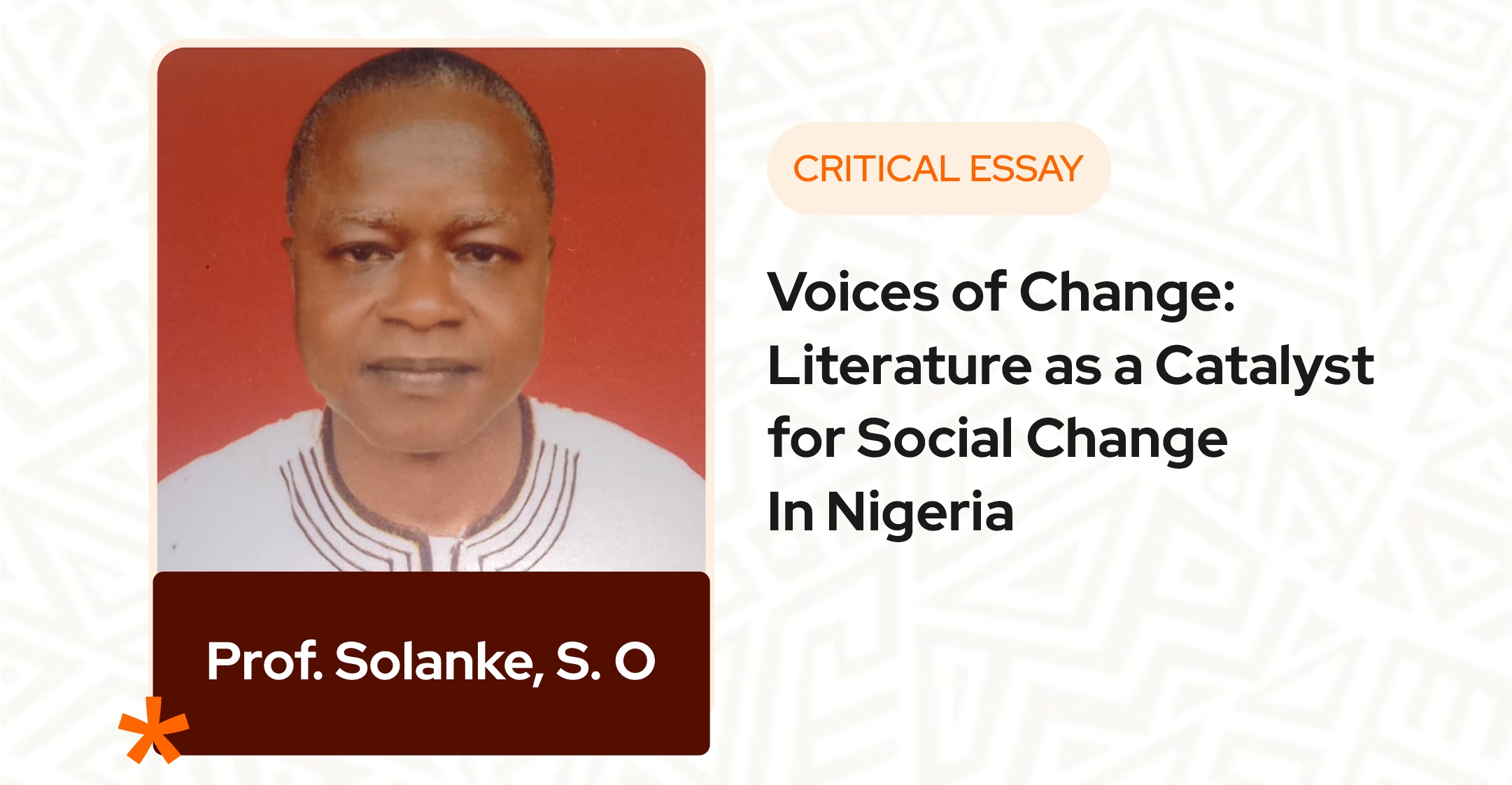
Prof. Stephen O. Solanke was born in Lagos, Nigeria. He holds a B.A. (Ed.) in English Language from Adeyemi College of Education, Ondo (affiliated with Obafemi Awolowo University), an M.Ed. in Educational Management from the University of Ilorin, and both an M.A. and a PhD in English (Literature) from the University of Ibadan.
He is the author of Poetic Analyses for Senior Secondary Schools, Literature in English Guide for Junior Secondary Schools, Anthology and Analyses of Poems for Senior Secondary Schools, Literary Guide for Junior Secondary Schools, 28 Poetic Voices, and a drama text, Alaafin Aole Arogangan. His poetic works, which have appeared in ACU Journal of Humanities (ACUJOH), Opuluiche, Alo, Con-Scio, africanwriter.com, 500 Nigerian Poets, and African Literature Today (ALT) amongst other avenues, include the poems, “we are,” “the now,” and “moo,” published by The International Library of Poetry’s The Woodland Echoes, where he received the Editor’s Choice Award in 1999.
Currently a Professor at Ajayi Crowther University, he specialises in Oral Literature, African Literature, Comparative Literature, and Creative Writing. He lives in Oyo, Nigeria, with his family. He is well published in national and international academic outlets.