
ABSTRACT
This paper examines the poetry of Denja Abdullahi, a prominent third generation writer in Nigeria, who is also a playwright and literary scholar. It begins by looking at his teething works which he first espoused on the pages of Nigerian newspapers in an era where the media was catalytic in the development of Nigerian literature. It traces Abdullahi’s gradual maturation thematically and stylistically into a notable poet both of his generation and indeed in Nigeria’s creative firmament. This process has seen him turn out an impressive harvest of over half a dozen volumes of poetry.
INTRODUCTION
Denja Abdullahi was born Augutst 27, 1969. He received a Bachelor of Arts degree (Honours) in English with Second Class Upper, from the University of Jos, in 1990. He thereafter earned a Master of Arts degree in Literature in English, from the University of Ilorin, in 1992. He taught English and Literature at the Waziri Umaru Federal Polytechnic, Birnin Kebbi, Kebbi State, between 1993 and 1998, before transferring his service to the National Council for Arts and Culture, (NCAC). He retired as Director of the Bauchi Zonal Directorate of the commission. He is a doctoral student in creative writing at the University of Abuja.
Abdullahi has published seven volumes of poetry: Mairogo: A Buffoon’s Poetic Journey Around Northern Nigeria (2001); The Talking Drum (2008); Abuja Nunyi (2008); A Thousand Years of Thirst (2011); Hajj Poems (2014); The Road to Bauchi and other Poems (2019) and Lovesongs in a Pandemic (2024). He has also published two volumes of plays, Death and the King’s Grey Hair and other Plays (2014), and Chants in a Cemetery, (2025). His first collection of poems, Mairogo, received an honourable mention for the “Association of Nigerian Authors, (ANA)/Cadbury Poetry Prize,” in 2001; he won the 2015 edition of the Society of Nigerian Theatre Arts, (SONTA), Playwright Prize, and was a finalist in the 2018 “NLNG Nigeria Prize for Literature,” (Drama). He has been honoured by the Federal Government with the “National Productivity Order of Merit,” (NPOM).
With Joe Ushie, Abdullahi has co-edited two volumes of seminal works, notably: Themes Fall Apart, But the Centre Holds (2009), published to commemorate the 50th Anniversary of the publication of Chinua Achebe’s Things Fall Apart, and Arrows or Gods: Essays on the Leadership Question in Chinua Achebe’s Arrow of God (2017), also to mark half a century of the release of Achebe’s Arrow of God. Abdullahi has also edited Medicine and Literature Without Borders: Health and Social Justice in the Writing’s of Wale Okediran (2025).
He was the pioneer Chairman of the Kebbi State chapter of ANA, from 1993 to 1998; General Secretary of the national body from 2005 to 2009 and was National President of the Association since 2015. He has been a journalist, having worked with the Independent Communications Network Ltd, publishers of The News magazine, as well as AM News and Tempo, in the mid-1990s. Denja Abdullahi has attended international literary festivals and participated in writers’ resident programmes in Ghana, Senegal and South Korea. The United Nation’s Educational Scientific and Cultural Organisation, (UNESCO), has recognised Abdullahi, as an expert and facilitator on Intangible Cultural Heritage.
THE POETRY OF DENJA ABDULLAHI
Abdullahi pays tribute to the role of the newspaper in nurturing his creative talent. Abdullahi notes in On His Turf: Collected Interviews on Arts, Literary and Cultural Administration (2009 – 2015) published 2015, that “I remember I had my first published piece in The Herald newspaper of Ilorin while I was in Form Two or Form Three, in the secondary school…” (p.91).
He continued to develop his craft on the pages of various Nigerian tabloids and had a substantial part of his early poetry published in newspapers such as National Concord, Nigerian Standard and Nigerian Tribune:
They (newspapers) did contribute to my growth as they offered me my very first public audience. The first places budding poets get published then, were in those outfits. Full-length poetry books or anthologies were not very common as at that time. The feedback you got then as a young writer seeing your work being published in those newspapers was uplifting and hugely impactful on your self-worth as a writer, and that gave you more impetus to write.
Like most other writers of his generation, Abdullahi is concerned about a plethora of topical issues, notably poverty, corruption, virtues and human inter-relationships. He conceives of poetry as socially committed art which must address itself to highlighting social ills and articulating remediations to such manifest distortions.
In his debut collection of poetry, Mairogo (2001), for instance, the poverty of the hoi- polloi is portrayed through the lenses of the poet persona, Mairogo, the comic, quasi- demented character, who is representative of the lowest in the society.
First, Mairogo is homeless, and he confesses this without reservations when he says:
Mairogo needs no house or shelter The wide world is just enough for me And I do always remember
That when Allah created the world
He hired no Dan Kwangila to build for man
Without worry I transverse all day
Creating home on any empty piece of land
(Mairogo…, p.4)
Daniel and Umaru (2009), have suggested that Abdullahi is deeply concerned about the gulf between the haves and the have nots. According to them, “the poet expresses concern over the plight of the poor as the wealthy in their lofty palaces loot public wealth to enrich themselves.” This reality, is best illustrated in the following verses from Mairogo:
Ah, the life of the poor is hard in this land The poor have a befitting name, Talakawa Theirs is to laze away before
Magnificent slippers and sandals
While the anointed pray in a mosque
To the beneficent God
For all these, they receive paltry handouts Pungent enough to quell only the next hunger I accept Mairogo is far too gone
Into the nothing world.
ECOLOGICAL IMPARTATIONS ON THE POETRY OF DENJA ABDULLAHI
As we would see in the subsequent discourse on Abdullahi’s work, there is a pervading, permeating Northern canvas in his poetry. Nigeria is noted for its rich cultural and linguistic diversity. Abdullahi’s tendency towards a Northern ambience in his work is hardly unexpected for several reasons. In the first place, because of Nigeria’s geo-politics, he comes from what is called the “North Central” zone. This comprises of six states at the geographical centre of Nigeria: Kwara, Kogi, Niger, Plateau, Nasarawa and Benue. Elsewhere, this area has also been referred to, as the “Middle Belt” of Nigeria and is the primordial conundrum of languages and confluence of cultures. Abdullahi is from the Oworo ethnic stock in Lokoja local government area, in Kogi State, which speaks a variant of Okun-Yoruba, called Oworo.
Critically, in the years after his early education in Ilorin, Kwara State, Abdullahi has lived a substantial part of his adult life both as a student and as a cultural activist, in the north of Nigeria. For instance, he attended the University of Jos in Plateau State, for his first degree in English. After that, he underwent the mandatory one-year National Youth Service Corps, NYSC, in Kebbi State in North-Western Nigeria. He stayed back in Kebbi State and worked as a lecturer at the Waziri Usman Federal Polytechnic, Birnin Kebbi, and was the Zonal Director for the National Council for Arts and Culture, NCAC, Bauchi zone, in North-East Nigeria.
Expectedly, therefore, these experiences have continued to influence his worldview and poetic disposition. The poem Mairogo he once said, was influenced by the culture shock he experienced transiting from Ilorin with its heavily South-Western customs, cultures, and Nuances, to Jos, for university studies, in the late 1980s. He notes: “I recollect penning my first conscious poem after encountering almajiris feasting like vultures on leftover food at a restaurant in Jos main market. That incident was a culture shock for me.”
Abdullahi’s second poetry collection, The Talking Drum (2008), according to the blurb, addresses vital aspects of history, culture and heritage of the people of Nigeria.” Oladokun (2011), informs us that:
From the very first poem which carries the title of the book, the reader is nudged to prepare for a journey into the captivating world of a story- teller…. The first poem also brings memories of a palace atmosphere in traditional societies, where drummers rouse the royalty from bed with a breakfast performance. Gladly, this remains the practice in some part of Nigeria and Africa.
The Talking Drum therefore, takes us to the North of Nigeria, where significant events are celebrated in the carnival ambience of colourful durbars and polo sports. Such events are reserved for special days like the Sallah celebration. The installation of an Emir or the visit of a dignitary of the stature of a President or Governor, could also necessitate such a spectacle. Abdullahi nostalgically reminds us of the beauty and splendour of that festival in “Marvel of the Durbar”:
…. During Sallah celebration
At Kano, Katsina, Zaria, Maiduguri
And at the places where there is royalty
We catch glimpses of a glorious part
As we watch a precession of colour and
Pageantry.
(Talking Drum…, p. 13)
He underscores the cross-cultural, pan-national practice of celebration, when he takes his readers both to the riverine South-South territory of Nigeria and the communities abutting the River Niger in “The Riverside Carnival”, and says:
… Tell Preye and Nda to bring their boats
Ready for the carnival at the riverside
Let them adorn with all colours of nature
Let them learn the fluid ways of the river.
(Talking Drum…, p. 16)
Spectacular regattas are hallmarks of coastal and riverine communities, some of them commanding hundreds of performers decked in elegant sartorial motifs.
Abdullahi’s third volume of poetry, Abuja Nunyi (2008), has been described by Abdul-Jabbar (2008), as “the poetry of the city”. Abuja Nunyi is the Gbagyi expression for “This is Abuja.” The Gbagyis were the early settlers in the geographical space that was designated the new Federal Capital Territory by the administration of General Murtala Ramat Mohammed in 1976 and appropriated for the development of a new capital area, by the Government of Federal Republic of Nigeria. Given its contemporary transformation from its pristine innocence into a modern, world-class city, today’s Abuja comes with the defining characteristics of city life. In a way, therefore, Abuja Nunyi is something of a poetic tour guide, perhaps a Nigerian variant of Remi Raji’s Shuttlesongs: America – A Poetic Guided Tour (2003), which should help the visitor or enthusiast on Abuja matters, have an artistic glimpse of the city.
The first poem in the section, “City Gate,” embraces guests of the city:
You are welcome
You visitors and wayfarers
By air or by road
To share in the dreams of this city
You are welcome
To fill her streets with possibilities
Not litter them with dirt and prejudices. (Abuja Nunyi, p. 14)
Much as Abdullahi recognises the new status of Abuja as a contemporary global destination, he remembers to pay tribute to the primordial Abuja, pre-transmutation, in the second section of the collection, “Native Songs”. He celebrates the natural rocky ecoscape of Abuja in “City of Rocks” when he venerates the dominant Zuma, Wubape, Aso and Katampe rocks and hills, which hedge the capital city in various locations. The traditional Gbagyi woman is equally adulated for her toils and enterprise on her children and family in the poem with the same name:
She carries yams, firewood And the burden of the race On her frail shoulder…
She looks away as modernity beckons
She prefers toiling to feed her brood … Singing the songs, rocking the pots
Telling the stories to her eager children
She is the rainbow woman.
(Abuja Nunyi…, p. 24)
The old, rustic, rural Abuja, yields a new capital in “Songs on the Lips of Modern Abuja,” where the seat of government in Aso Rock, is pictured in “Aso Villa,” as a sprawling, hedged fortressed creation. Despite being on some elevated height, the poet can only see very little of the presidential palace:
Even on this height
I can only see the fringes: Whitened out barricades, linking One of the many gates
Manned by lonely sentries…
To the many barracks
Laying siege on the Villa.
(Abuja Nunyi…, p. 35)
The attempted coup of April 22, 1990, led by Major Gideon Gwaza Orkar to oust the regime of General Babangida, was a wake-up call to Babangida, not only to expedite the relocation of the seat of Federal administration from Lagos, but to internationally fortify the new State House, as evidenced by the several surrounding military barracks. “Abuja Babes,” “Zone 4,” “Area 10” and “Berger Junction,” all speak about life in the new capital, the hustling young ladies who see in Abuja the new goldmine; the women of easy virtue who ply their trade under the cover of night in Zone 4 District; the bustling commercial district of Area 10, and the Abuja equivalent of Ojuelegba in primordial Lagos, which is re-enacted in “Berger Junction.”
A Thousand Years of Thirst (2011), Abdullahi’s fourth collection of poetry re-echoes the earlier themes of the poet as a voyeur, which Abdullahi established in his earlier poetry collections. The dominant image of “thirst” in the collection, is that of a quester for a rebirth, a regeneration across various spheres of public life in his home country. He admonishes the reader:
Let us not think about the love we lost
At the threshold of doubts
Let us not rave at the chances gone by
Purging ourselves of cancerous dejection.
Let us not weep at the graveside of our dreams
From our spent tears can spring a troubled ghost.
Let us in newfound love
Recreate the old.
Let us in knocking chances
Open our doors for those that are past. Let us at the birth of a new dream Resurrect the one in our memories.
(A Thousand Years…, p. 31)
The poem is a wake-up call to nationalism and the rediscovery of new African heritage and identity. The poet admonishes that we pick up the pieces of our chequered past and aspire for a more glorious future.
Abdullahi’s “The King Spat on Us” and “Africa Kills it Son” are poems which re- echo the socio-political sensitivity of Abdullahi. The earlier poem indeed re-echoes Tunde Olusunle’s “The King’s Visit” Published in Rhythm of the Mortar, (2001, 2023). Even as the community resolved to stage a peace walk to the king’s palace to protest hunger, famine and disease in the “King Spat on Us,” the royalty made a highly disdainful appearance at the palace gate and responded by deriding the aggrieved populace:
Hunger visited our homes
Refusing to depart
Bold death rushed in
Making no man a compromise. We rushed to the King
Carrying our crosses to the palace Forever brimming with fathered women In a land of shrunken buttocks….
The king came out with oily hands
Vestiges of a battle with a lamb We rushed forward crying Shouting, pleading, bowing
But alas, the king spat on us.
(A Thousand…, p. 53)
“Africa Kills Her Son” is dedicated to Ken Saro-Wiwa, an accomplished writer and Ogoni Rights Activist, who was killed by hanging, in the administration of General Sani Abacha, November 10, 1995. A distraught Abdullahi wonders why physical extermination has become a lot of many of Africa’s shining lights, who dared to question the establishment for misrule and corruption. Ezeanah (2011) in a review of the poetry volume, titled: “Seeking An Oasis for an Eternity of Thirst: A Review of Denja Abdullahi’s A Thousand Years of Thirst,” notes that “Abdullahi’s verses also re-echo the tragic end the other “irritants” and “noisemakers” like Lumumba, Biko, Giwa, Murtala, Samora and Sankara, who died in the quest for justice for all.”
CONCLUSION
Abdullahi has continued to grow as a poet, since his ascent from the pages of the newspaper. Both in his vision and style, he has moved, from the experimental tentativeness of his debut collection of poems, Mairogo, to the more assured A Thousand Years of Thirst, and thereafter to The Road to Bauchi and Other Poems, and Lovesongs in a Pandemic. Eze (2025) notes that Denja Abdullahi is more than a name in the Nigerian Literary space. According to him, he is “a prolific poet, accomplished playwright, cultural advocate, essayist.” For him, Abdullahi’s works “connect generation and genres, reminding us that storytelling is not just a craft, but a cultural duty.”
REFRENCES
- Abdullahi, D. (2008). Abuja Nunyi: This is Abuja. Ibadan: Kraft Books Ltd.
- Abdullahi, D. (2008). The Talking Drum. Abuja: Nabsadau Ventures.
- Abdullahi, D. (2009). Mairogo: A Buffoon’s Poetic Journey Around Northern Nigeria. Abuja: Nabsadau Ventures.
- Abdullahi, D. (2011). A Thousand Years of Thirst. Ibadan: Kraft Books Ltd.
- Abdul-Jabbar, O. A. (2008). “The Poet and the City: Denja Abdullahi’s Abuja Nunyi in Full Dissection.” Unpublished book review.
- Eze, C. (2025). Remarks at 56th Birthday Soiree for Denja Abdullahi. Unpublished
- Ezeanah, C. (2011). “Seeking An Oasis for an Eternity of Thirst.” Unpublished Paper.
- Oladokun, T. (2011). “A Review of Talking Drum Written by Denja Abdullahi.” Unpublished Paper.
- Olusunle, T. (2015). “Poetry Has Benefitted from the Print Media, More than any other Genre in Nigeria,” in Abdullahi, Denja (ed.). On His Turf: Collected Interviews on Arts, Literacy and Cultural Administration (2009 – 2015). Lagos: Sovethy For Everybody Ventures, (SFEV)
- Olusunle, T. (2001, 2023). Rhythm of the Mortar Ibadan: Kraft Books Ltd. Pp. 31 – 33.
- Raji, R. (2003). Shuttlesongs America: A Poetic Guided Tour. Ibadan: Kraft Books Ltd.
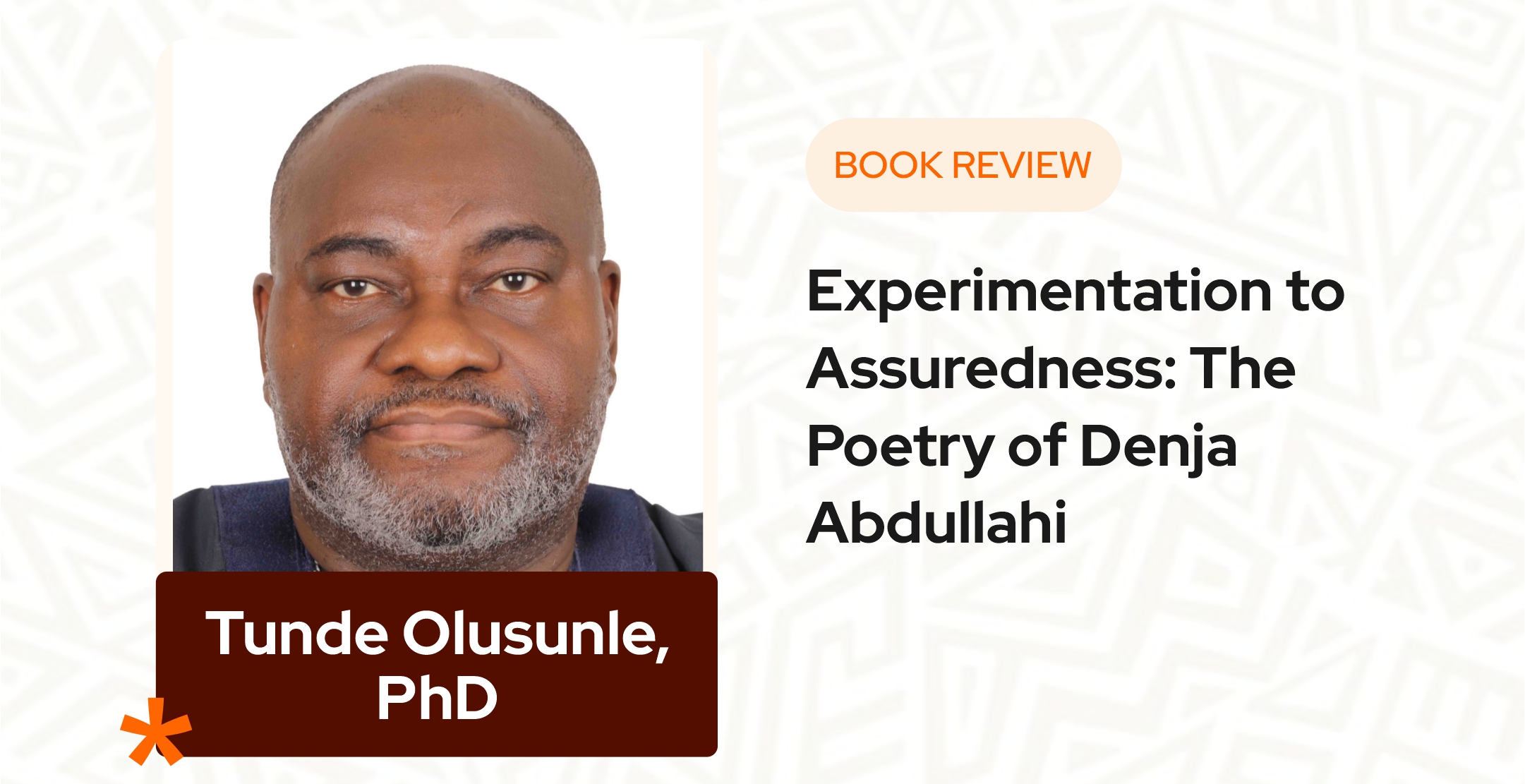
Tunde Olusunle, PhD, holds Bachelor’s (1985) and Master’s (1989) degrees in English from the University of Ilorin. He also earned a Doctorate in Media Arts from the University of Abuja in 2020 and supports the Centre for Creative Writing. He is a very prolific poet and journalist with over half a dozen titles to his name, and a well-published scholar in reputable national and international journals and books.