
Bereavement, as we know it, is not a thing of joy. When someone dies, their families, friends and acquaintances experience shock, unbelief, sadness and a sense of dread. It is at the moment of death that many are sober to such an extent that they reflect on their past behaviours and past life experiences with a promise to live better lives, abet after a time, depending on the closeness of the bereaved individual to the dead, he/she goes on with life putting his/her sadness behind. However, the loss of a loved one is never a happy one- it is a battle to remember, a battle to continue living and a battle to hold on to the love once shared.
Abdullahi’s The rainbow is not as Beautiful as my Ruins is a book of poems that juggles one’s experience with the process of death. From poem-to-poem readers get to grieve along with the poet personae as they move from health to sickness to traumatic sufferings, death and finally the psychological implications of losing loved ones. We see a linear chronicle of bereavement in The Rainbow is not as Beautiful as My ruins right from the first poem titled “Why?” In this poem, Abdullahi gives reasons for so many likely possibilities of death as can be deciphered in the following: “-because home is a minefield/-because the boy that heard the sound ran mad/ -because all my lovers died the day after I killed our neighbor’s cat…” (p.1). Furthermore, in the poem “Here is Water, Drink”, the poet is anxious, worried and desperate seeing that the “body” of his loved one “breaks more than the attics can hold” (p. 4). The poet is engulfed in anticipating a relief even though he does not know the name of the sickness: “you spend every night questioning your shadow, what it means to be broken/ like sickness, you felt it, but do not have a word for it./ you let it have its way like your body is a shoe & it is the lace…” (p. 4).
The build up from asking questions to the desperation of wanting to know the name of the sickness and how it slowly kills his brother, culminates into the day the brother is consumed by the sickness. The poem entitled “The Morning My Brother Died” shatters the entirety of the poet personae that he literally becomes a mad man trying to decipher why his brother died. We can see the persona’s confused state of presence in these words:
Ma grabbed his favourite photo, moulded it into a skin & wore it as clothing.
I did not blame her, I too, know what becomes of the night when the moon is put to shame.
She sat close to his room & listened as the walls whispered his absence. Mubaraq, can you hear me? Her wrapper falling off her waist like oversized beads…
…inside, I stood befor a mirror, counting the weightlessness of his dreams. Shattered, I knelt down and mourned alongside his shadow. Believe me, I did not break. I was everything but broken…Mubaraq is not dead. He’s somewhere exiling into the silence of god (p. 5).
From the excerpt, we find that the sudden death throws the persona and the mother into a state of delirium. They are beside themselves with extreme sadness and refuse to accept their loss. The death of the personae brother/son overwhelms their sanity, and they are thrown into a violent subconscious battle to accept the demise of their loved one and all hell is let lose in their will to accept their loss.
What is most traumatizing in grieving the loss of a loved one according to Abdullahi, is suffering identity crisis due to a subconscious battle to separate the reality of death from the dreams/desires or wishes of a bereaved one that never include death. “Tribute to the War Waging in My head” is the acknowledgment of the poet persona’s brash struggle with accepting his loss or denying the end of a life. The following words encapsulate the persona’s transition into a bipolar state: “that day at a gathering, when a woman pointed her finger at me, I confirmed I am everything the war broke into goodnight. There are days when the war spreads from my head to the rest of my body; days when I do not belong anywhere, even in this poem, days when I’d enter into mornings hoping to know happiness tastes likes.”
This prosaic poem ushers’ readers into a gateway into the sub-consciousness of a person battling with grief. As a reader reads through the lines, a picture of the persona going through psychological trauma is so vivid that the reader is drawn into deep reflection on dying as a phenomenon of life that perplexes the human mind. Abdullahi’s words do not just reflect sorrow, confusion and hopelessness, it provides strength in the brutal reality of loss, beauty in consolidating one’s loss and one’s hope and finally realigning dashed hopes to the ruins created by loss and the need to live in an unpredictable future. That is why Ba Sabouke, the author of Meccan Spring would state that Abdullahi’s The Rainbow is Not as Beautiful as My Ruins is “ a brutal beauty of bereavement and one that makes readers tremble in vulnerability”.
Furthermore, readers can decipher that Abdullahi’s representation of a bipolar individual- who shifts from sorrow to near madness because of the demise of his brother- is overwhelmed by nostalgic memories of his beloved brother. The pain is intense as he remembers “twenty things” about his brother as can be read in the following poem titled “Twenty Things that Remind Me of My Late Brother”:
-bad poetry/-palisades of clouds/-water/-fire/-a cosmic clock/-a bonny meat/…/the presence of nothing/-the cacophony of silence/a door/-promises/-mango fruit/-the absence of white/-an opening/-thighs of women/-rejection emails/-punctuation marks/-nights/-tomorrow (p. 14).
From the excerpt it can be deduced that the sufferer is in a state of delusion, shock and disbelief that is why every little thing that is associated with his brother is written down to remember his dearly beloved. Even “punctuation” (perhaps his brother never punctuated his essays) is listed as one of the twenty things he remembers about his brother. We may say that “punctuation” here is just a word which may describe his association with his brother through writing, yet his inner mind holds on to this minute detail and the poet persona suffer from the memory of his brother’s use of punctuation marks. Written in an elliptical manner, this poem underscores the tremendous trauma that is experienced by a bereaved person and therefore calls to mind how so many people suffer in silence as they remember the little things that are unique to their dead loved ones. It is also critical to observe that the persona recalls things about the dead with kin love, closeness and accuracy that readers would feel empathy for the poet persona(e) as they read from page to page.
Another poem that similarly heightens the sorrow of the poet persona is “Final Dialysis”. “Final Dialysis” captures the processes of undergoing treatment for kidney failure. Dialysis is not a common term/word that most people would know, and, in this poem, it was shrouded in mystery. However, at the beginning of the poem, readers get to know that “Final Dialysis” is connected to the hospital through the word “theatre” and the brother is in tears over his ordeal:
Entering the theatre, my brother’s eyes bulged like a frog’s. before the final dialysis, he said he would be fine. Our prayers became terrors- (p. 13).
We should notice that the fear that envelope the family was so overwhelming that their “prayers became terrors-, signifying that they were already mourning even before the death of their beloved son/brother. Those who have lost a child would never want to recall their loss, grief and guilt of surviving their child, hence, “Pa (the father of the poet persona and the sick person) “crumbles on the stairs, hands clasping loss like flagella.” Every word of this poem magnifies the terrible pains family members go through when a loved one suffers a terminal sickness or disease. As a patient is being taken to the theatre, members of his/her family hold desperately to the belief that their loved one will come back alive but the other knowledge of a possibility of death is always never expected.
From “Final Dialysis” readers are abruptly made to visualize a hospital. A hospital bed, the sufferer so frail and without hope and his family totally consumed by sorrow, pain and anxiousness. No one wants to accept the possibility of death, yet it is undoubtedly glaring that the persona will die from kidney disease which is why he is placed on dialysis in the first place. The following depicts the poet’s understanding of his brother not making it after this dialysis that would be the last for his brother: “he parted with his shadow long before everyone noticed-before he grew a world apart from his body, before the cannula became a bone his system recognizes” (p.13).
For as much as one would want to avoid the pains of death, Abdullahi in this collection, turns his tragic experience into a novel way of overcoming the loss of a loved one. Even though the trauma can be so overwhelming, one can be at peace by remembering the life of loved one and accepting the fact that his/her life was a gift- a relationship that would last forever.
Finally, in its entirety, Abdullahi’s The Rainbow is not as Beautiful as My Ruins is a bold step towards drawing the lines between death and life, sorrow and happiness. With the need to translate his grief to the world, Abdullahi’s intense trauma becomes a channel to safeguard his emotions and his overall mental health. Instead of suffering identity crisis from the death of a loved one, Abdullahi gives us a glimpse of what it would be like to be bereaved and still be sane when everything thing around the bereaved tells him/her to deny his/her existence. With regards to the aesthetic presentation, the book cover with skeleton, flowers and burnt ashes suggests a gloomy narrative and prepares readers for an encounter with death. However, the font is too small and can make reading a difficult task. The publishers probably reduced the fonts to decrease the number of pages to cut cost, but this is the drawback of this book. The book looks more like a pamphlet which front cover is both beautiful and scary but the back page is a write off- with praises of the book written in tiny fonts and separating individual praise with lines thus making the back cover look like a narrative table of instructions.
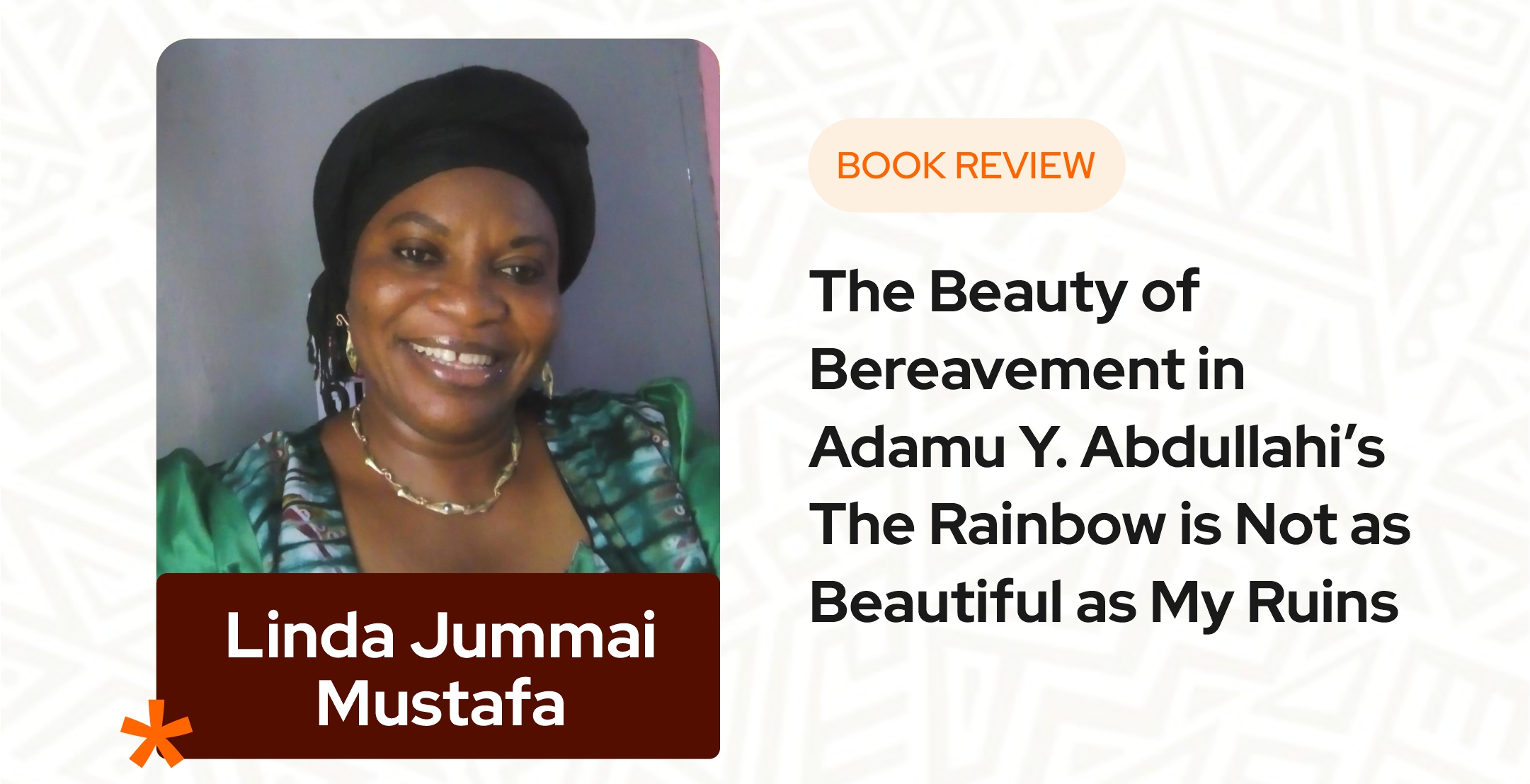
Linda Jummai Mustafa teaches Literature-In-English at IBB University, Lapai, Niger State. She is also a novelist and a poet and has written several academic papers.